
Get trending papers in your email inbox once a day!
Get trending papers in your email inbox!
Subscribe
The Euclidean Space is Evil: Hyperbolic Attribute Editing for Few-shot Image Generation
Few-shot image generation is a challenging task since it aims to generate diverse new images for an unseen category with only a few images. Existing methods suffer from the trade-off between the quality and diversity of generated images. To tackle this problem, we propose Hyperbolic Attribute Editing~(HAE), a simple yet effective method. Unlike other methods that work in Euclidean space, HAE captures the hierarchy among images using data from seen categories in hyperbolic space. Given a well-trained HAE, images of unseen categories can be generated by moving the latent code of a given image toward any meaningful directions in the Poincar\'e disk with a fixing radius. Most importantly, the hyperbolic space allows us to control the semantic diversity of the generated images by setting different radii in the disk. Extensive experiments and visualizations demonstrate that HAE is capable of not only generating images with promising quality and diversity using limited data but achieving a highly controllable and interpretable editing process.
Vietoris--Rips Shadow for Euclidean Graph Reconstruction
The shadow of an abstract simplicial complex K with vertices in R^N is a subset of R^N defined as the union of the convex hulls of simplices of K. The Vietoris--Rips complex of a metric space (S,d) at scale β is an abstract simplicial complex whose each k-simplex corresponds to (k+1) points of S within diameter β. In case Ssubsetmathbb R^2 and d(a,b)=|a-b| the standard Euclidean metric, the natural shadow projection of the Vietoris--Rips complex is already proved by Chambers et al. to induce isomorphisms on π_0 and π_1. We extend the result beyond the standard Euclidean distance on Ssubsetmathbb R^N to a family of path-based metrics, d^varepsilon_{S}. From the pairwise Euclidean distances of points in S, we introduce a family (parametrized by varepsilon) of path-based Vietoris--Rips complexes R^varepsilon_β(S) for a scale β>0. If SsubsetR^2 is Hausdorff-close to a planar Euclidean graph G, we provide quantitative bounds on scales β,varepsilon for the shadow projection map of the Vietoris--Rips complex of (S,d^varepsilon_S) at scale β to induce π_1-isomorphism. This paper first studies the homotopy-type recovery of Gsubsetmathbb R^N using the abstract Vietoris--Rips complex of a Hausdorff-close sample S under the d^varepsilon_S metric. Then, our result on the π_1-isomorphism induced by the shadow projection lends itself to providing also a geometrically close embedding for the reconstruction. Based on the length of the shortest loop and large-scale distortion of the embedding of G, we quantify the choice of a suitable sample density varepsilon and a scale β at which the shadow of R^varepsilon_β(S) is homotopy-equivalent and Hausdorff-close to G.
A Graph is Worth $K$ Words: Euclideanizing Graph using Pure Transformer
Can we model non-Euclidean graphs as pure language or even Euclidean vectors while retaining their inherent information? The non-Euclidean property have posed a long term challenge in graph modeling. Despite recent GNN and Graphformer efforts encoding graphs as Euclidean vectors, recovering original graph from the vectors remains a challenge. We introduce GraphsGPT, featuring a Graph2Seq encoder that transforms non-Euclidean graphs into learnable graph words in a Euclidean space, along with a GraphGPT decoder that reconstructs the original graph from graph words to ensure information equivalence. We pretrain GraphsGPT on 100M molecules and yield some interesting findings: (1) Pretrained Graph2Seq excels in graph representation learning, achieving state-of-the-art results on 8/9 graph classification and regression tasks. (2) Pretrained GraphGPT serves as a strong graph generator, demonstrated by its ability to perform both unconditional and conditional graph generation. (3) Graph2Seq+GraphGPT enables effective graph mixup in the Euclidean space, overcoming previously known non-Euclidean challenge. (4) Our proposed novel edge-centric GPT pretraining task is effective in graph fields, underscoring its success in both representation and generation.


On Coresets for Clustering in Small Dimensional Euclidean Spaces
We consider the problem of constructing small coresets for k-Median in Euclidean spaces. Given a large set of data points Psubset R^d, a coreset is a much smaller set Ssubset R^d, so that the k-Median costs of any k centers w.r.t. P and S are close. Existing literature mainly focuses on the high-dimension case and there has been great success in obtaining dimension-independent bounds, whereas the case for small d is largely unexplored. Considering many applications of Euclidean clustering algorithms are in small dimensions and the lack of systematic studies in the current literature, this paper investigates coresets for k-Median in small dimensions. For small d, a natural question is whether existing near-optimal dimension-independent bounds can be significantly improved. We provide affirmative answers to this question for a range of parameters. Moreover, new lower bound results are also proved, which are the highest for small d. In particular, we completely settle the coreset size bound for 1-d k-Median (up to log factors). Interestingly, our results imply a strong separation between 1-d 1-Median and 1-d 2-Median. As far as we know, this is the first such separation between k=1 and k=2 in any dimension.

Deep Squared Euclidean Approximation to the Levenshtein Distance for DNA Storage
Storing information in DNA molecules is of great interest because of its advantages in longevity, high storage density, and low maintenance cost. A key step in the DNA storage pipeline is to efficiently cluster the retrieved DNA sequences according to their similarities. Levenshtein distance is the most suitable metric on the similarity between two DNA sequences, but it is inferior in terms of computational complexity and less compatible with mature clustering algorithms. In this work, we propose a novel deep squared Euclidean embedding for DNA sequences using Siamese neural network, squared Euclidean embedding, and chi-squared regression. The Levenshtein distance is approximated by the squared Euclidean distance between the embedding vectors, which is fast calculated and clustering algorithm friendly. The proposed approach is analyzed theoretically and experimentally. The results show that the proposed embedding is efficient and robust.
Voxblox: Incremental 3D Euclidean Signed Distance Fields for On-Board MAV Planning
Micro Aerial Vehicles (MAVs) that operate in unstructured, unexplored environments require fast and flexible local planning, which can replan when new parts of the map are explored. Trajectory optimization methods fulfill these needs, but require obstacle distance information, which can be given by Euclidean Signed Distance Fields (ESDFs). We propose a method to incrementally build ESDFs from Truncated Signed Distance Fields (TSDFs), a common implicit surface representation used in computer graphics and vision. TSDFs are fast to build and smooth out sensor noise over many observations, and are designed to produce surface meshes. Meshes allow human operators to get a better assessment of the robot's environment, and set high-level mission goals. We show that we can build TSDFs faster than Octomaps, and that it is more accurate to build ESDFs out of TSDFs than occupancy maps. Our complete system, called voxblox, will be available as open source and runs in real-time on a single CPU core. We validate our approach on-board an MAV, by using our system with a trajectory optimization local planner, entirely on-board and in real-time.
Manify: A Python Library for Learning Non-Euclidean Representations
We present Manify, an open-source Python library for non-Euclidean representation learning. Leveraging manifold learning techniques, Manify provides tools for learning embeddings in (products of) non-Euclidean spaces, performing classification and regression with data that lives in such spaces, and estimating the curvature of a manifold. Manify aims to advance research and applications in machine learning by offering a comprehensive suite of tools for manifold-based data analysis. Our source code, examples, datasets, results, and documentation are available at https://github.com/pchlenski/manify
Strategy Proof Mechanisms for Facility Location in Euclidean and Manhattan Space
We study the impact on mechanisms for facility location of moving from one dimension to two (or more) dimensions and Euclidean or Manhattan distances. We consider three fundamental axiomatic properties: anonymity which is a basic fairness property, Pareto optimality which is one of the most important efficiency properties, and strategy proofness which ensures agents do not have an incentive to mis-report. We also consider how well such mechanisms can approximate the optimal welfare. Our results are somewhat negative. Moving from one dimension to two (or more) dimensions often makes these axiomatic properties more difficult to achieve. For example, with two facilities in Euclidean space or with just a single facility in Manhattan space, no mechanism is anonymous, Pareto optimal and strategy proof. By contrast, mechanisms on the line exist with all three properties.We also show that approximation ratios may increase when moving to two (or more) dimensions. All our impossibility results are minimal. If we drop one of the three axioms (anonymity, Pareto optimality or strategy proofness) multiple mechanisms satisfy the other two axioms.
Sparse Spectral Training and Inference on Euclidean and Hyperbolic Neural Networks
The growing computational demands posed by increasingly number of neural network's parameters necessitate low-memory-consumption training approaches. Previous memory reduction techniques, such as Low-Rank Adaptation (LoRA) and ReLoRA, suffer from the limitation of low rank and saddle point issues, particularly during intensive tasks like pre-training. In this paper, we propose Sparse Spectral Training (SST), an advanced training methodology that updates all singular values and selectively updates singular vectors of network weights, thereby optimizing resource usage while closely approximating full-rank training. SST refines the training process by employing a targeted updating strategy for singular vectors, which is determined by a multinomial sampling method weighted by the significance of the singular values, ensuring both high performance and memory reduction. Through comprehensive testing on both Euclidean and hyperbolic neural networks across various tasks, including natural language generation, machine translation, node classification and link prediction, SST demonstrates its capability to outperform existing memory reduction training methods and is comparable with full-rank training in some cases. On OPT-125M, with rank equating to 8.3% of embedding dimension, SST reduces the perplexity gap to full-rank training by 67.6%, demonstrating a significant reduction of the performance loss with prevalent low-rank methods. This approach offers a strong alternative to traditional training techniques, paving the way for more efficient and scalable neural network training solutions.
Interpreting and Improving Diffusion Models Using the Euclidean Distance Function
Denoising is intuitively related to projection. Indeed, under the manifold hypothesis, adding random noise is approximately equivalent to orthogonal perturbation. Hence, learning to denoise is approximately learning to project. In this paper, we use this observation to reinterpret denoising diffusion models as approximate gradient descent applied to the Euclidean distance function. We then provide straight-forward convergence analysis of the DDIM sampler under simple assumptions on the projection-error of the denoiser. Finally, we propose a new sampler based on two simple modifications to DDIM using insights from our theoretical results. In as few as 5-10 function evaluations, our sampler achieves state-of-the-art FID scores on pretrained CIFAR-10 and CelebA models and can generate high quality samples on latent diffusion models.

Multi-Fidelity Covariance Estimation in the Log-Euclidean Geometry
We introduce a multi-fidelity estimator of covariance matrices that employs the log-Euclidean geometry of the symmetric positive-definite manifold. The estimator fuses samples from a hierarchy of data sources of differing fidelities and costs for variance reduction while guaranteeing definiteness, in contrast with previous approaches. The new estimator makes covariance estimation tractable in applications where simulation or data collection is expensive; to that end, we develop an optimal sample allocation scheme that minimizes the mean-squared error of the estimator given a fixed budget. Guaranteed definiteness is crucial to metric learning, data assimilation, and other downstream tasks. Evaluations of our approach using data from physical applications (heat conduction, fluid dynamics) demonstrate more accurate metric learning and speedups of more than one order of magnitude compared to benchmarks.
Convolutional Neural Networks on non-uniform geometrical signals using Euclidean spectral transformation
Convolutional Neural Networks (CNN) have been successful in processing data signals that are uniformly sampled in the spatial domain (e.g., images). However, most data signals do not natively exist on a grid, and in the process of being sampled onto a uniform physical grid suffer significant aliasing error and information loss. Moreover, signals can exist in different topological structures as, for example, points, lines, surfaces and volumes. It has been challenging to analyze signals with mixed topologies (for example, point cloud with surface mesh). To this end, we develop mathematical formulations for Non-Uniform Fourier Transforms (NUFT) to directly, and optimally, sample nonuniform data signals of different topologies defined on a simplex mesh into the spectral domain with no spatial sampling error. The spectral transform is performed in the Euclidean space, which removes the translation ambiguity from works on the graph spectrum. Our representation has four distinct advantages: (1) the process causes no spatial sampling error during the initial sampling, (2) the generality of this approach provides a unified framework for using CNNs to analyze signals of mixed topologies, (3) it allows us to leverage state-of-the-art backbone CNN architectures for effective learning without having to design a particular architecture for a particular data structure in an ad-hoc fashion, and (4) the representation allows weighted meshes where each element has a different weight (i.e., texture) indicating local properties. We achieve results on par with the state-of-the-art for the 3D shape retrieval task, and a new state-of-the-art for the point cloud to surface reconstruction task.

Understanding Gradient Orthogonalization for Deep Learning via Non-Euclidean Trust-Region Optimization
Optimization with matrix gradient orthogonalization has recently demonstrated impressive results in the training of deep neural networks (Jordan et al., 2024; Liu et al., 2025). In this paper, we provide a theoretical analysis of this approach. In particular, we show that the orthogonalized gradient method can be seen as a first-order trust-region optimization method, where the trust-region is defined in terms of the matrix spectral norm. Motivated by this observation, we develop the stochastic non-Euclidean trust-region gradient method with momentum, which recovers the Muon optimizer (Jordan et al., 2024) as a special case, along with normalized SGD and signSGD with momentum (Cutkosky and Mehta, 2020; Sun et al., 2023). In addition, we prove state-of-the-art convergence results for the proposed algorithm in a range of scenarios, which involve arbitrary non-Euclidean norms, constrained and composite problems, and non-convex, star-convex, first- and second-order smooth functions. Finally, our theoretical findings provide an explanation for several practical observations, including the practical superiority of Muon compared to the Orthogonal-SGDM algorithm of Tuddenham et al. (2022) and the importance of weight decay in the training of large-scale language models.
Momentum-based minimization of the Ginzburg-Landau functional on Euclidean spaces and graphs
We study the momentum-based minimization of a diffuse perimeter functional on Euclidean spaces and on graphs with applications to semi-supervised classification tasks in machine learning. While the gradient flow in the task at hand is a parabolic partial differential equation, the momentum-method corresponds to a damped hyperbolic PDE, leading to qualitatively and quantitatively different trajectories. Using a convex-concave splitting-based FISTA-type time discretization, we demonstrate empirically that momentum can lead to faster convergence if the time step size is large but not too large. With large time steps, the PDE analysis offers only limited insight into the geometric behavior of solutions and typical hyperbolic phenomena like loss of regularity are not be observed in sample simulations.
Lift Your Molecules: Molecular Graph Generation in Latent Euclidean Space
We introduce a new framework for molecular graph generation with 3D molecular generative models. Our Synthetic Coordinate Embedding (SyCo) framework maps molecular graphs to Euclidean point clouds via synthetic conformer coordinates and learns the inverse map using an E(n)-Equivariant Graph Neural Network (EGNN). The induced point cloud-structured latent space is well-suited to apply existing 3D molecular generative models. This approach simplifies the graph generation problem - without relying on molecular fragments nor autoregressive decoding - into a point cloud generation problem followed by node and edge classification tasks. Further, we propose a novel similarity-constrained optimization scheme for 3D diffusion models based on inpainting and guidance. As a concrete implementation of our framework, we develop EDM-SyCo based on the E(3) Equivariant Diffusion Model (EDM). EDM-SyCo achieves state-of-the-art performance in distribution learning of molecular graphs, outperforming the best non-autoregressive methods by more than 30% on ZINC250K and 16% on the large-scale GuacaMol dataset while improving conditional generation by up to 3.9 times.
Geometric Neural Operators (GNPs) for Data-Driven Deep Learning of Non-Euclidean Operators
We introduce Geometric Neural Operators (GNPs) for accounting for geometric contributions in data-driven deep learning of operators. We show how GNPs can be used (i) to estimate geometric properties, such as the metric and curvatures, (ii) to approximate Partial Differential Equations (PDEs) on manifolds, (iii) learn solution maps for Laplace-Beltrami (LB) operators, and (iv) to solve Bayesian inverse problems for identifying manifold shapes. The methods allow for handling geometries of general shape including point-cloud representations. The developed GNPs provide approaches for incorporating the roles of geometry in data-driven learning of operators.

New asymptotically flat static vacuum metrics with near Euclidean boundary data
In our prior work toward Bartnik's static vacuum extension conjecture for near Euclidean boundary data, we establish a sufficient condition, called static regular, and confirm large classes of boundary hypersurfaces are static regular. In this note, we further improve some of those prior results. Specifically, we show that any hypersurface in an open and dense subfamily of a certain general smooth one-sided family of hypersurfaces (not necessarily a foliation) is static regular. The proof uses some of our new arguments motivated from studying the conjecture for boundary data near an arbitrary static vacuum metric.
Synaptic Weight Distributions Depend on the Geometry of Plasticity
A growing literature in computational neuroscience leverages gradient descent and learning algorithms that approximate it to study synaptic plasticity in the brain. However, the vast majority of this work ignores a critical underlying assumption: the choice of distance for synaptic changes - i.e. the geometry of synaptic plasticity. Gradient descent assumes that the distance is Euclidean, but many other distances are possible, and there is no reason that biology necessarily uses Euclidean geometry. Here, using the theoretical tools provided by mirror descent, we show that the distribution of synaptic weights will depend on the geometry of synaptic plasticity. We use these results to show that experimentally-observed log-normal weight distributions found in several brain areas are not consistent with standard gradient descent (i.e. a Euclidean geometry), but rather with non-Euclidean distances. Finally, we show that it should be possible to experimentally test for different synaptic geometries by comparing synaptic weight distributions before and after learning. Overall, our work shows that the current paradigm in theoretical work on synaptic plasticity that assumes Euclidean synaptic geometry may be misguided and that it should be possible to experimentally determine the true geometry of synaptic plasticity in the brain.
Fast and Eager k-Medoids Clustering: O(k) Runtime Improvement of the PAM, CLARA, and CLARANS Algorithms
Clustering non-Euclidean data is difficult, and one of the most used algorithms besides hierarchical clustering is the popular algorithm Partitioning Around Medoids (PAM), also simply referred to as k-medoids clustering. In Euclidean geometry the mean-as used in k-means-is a good estimator for the cluster center, but this does not exist for arbitrary dissimilarities. PAM uses the medoid instead, the object with the smallest dissimilarity to all others in the cluster. This notion of centrality can be used with any (dis-)similarity, and thus is of high relevance to many domains and applications. A key issue with PAM is its high run time cost. We propose modifications to the PAM algorithm that achieve an O(k)-fold speedup in the second ("SWAP") phase of the algorithm, but will still find the same results as the original PAM algorithm. If we relax the choice of swaps performed (while retaining comparable quality), we can further accelerate the algorithm by eagerly performing additional swaps in each iteration. With the substantially faster SWAP, we can now explore faster initialization strategies, because (i) the classic ("BUILD") initialization now becomes the bottleneck, and (ii) our swap is fast enough to compensate for worse starting conditions. We also show how the CLARA and CLARANS algorithms benefit from the proposed modifications. While we do not study the parallelization of our approach in this work, it can easily be combined with earlier approaches to use PAM and CLARA on big data (some of which use PAM as a subroutine, hence can immediately benefit from these improvements), where the performance with high k becomes increasingly important. In experiments on real data with k=100,200, we observed a 458x respectively 1191x speedup compared to the original PAM SWAP algorithm, making PAM applicable to larger data sets, and in particular to higher k.
Faster k-Medoids Clustering: Improving the PAM, CLARA, and CLARANS Algorithms
Clustering non-Euclidean data is difficult, and one of the most used algorithms besides hierarchical clustering is the popular algorithm Partitioning Around Medoids (PAM), also simply referred to as k-medoids. In Euclidean geometry the mean-as used in k-means-is a good estimator for the cluster center, but this does not hold for arbitrary dissimilarities. PAM uses the medoid instead, the object with the smallest dissimilarity to all others in the cluster. This notion of centrality can be used with any (dis-)similarity, and thus is of high relevance to many domains such as biology that require the use of Jaccard, Gower, or more complex distances. A key issue with PAM is its high run time cost. We propose modifications to the PAM algorithm to achieve an O(k)-fold speedup in the second SWAP phase of the algorithm, but will still find the same results as the original PAM algorithm. If we slightly relax the choice of swaps performed (at comparable quality), we can further accelerate the algorithm by performing up to k swaps in each iteration. With the substantially faster SWAP, we can now also explore alternative strategies for choosing the initial medoids. We also show how the CLARA and CLARANS algorithms benefit from these modifications. It can easily be combined with earlier approaches to use PAM and CLARA on big data (some of which use PAM as a subroutine, hence can immediately benefit from these improvements), where the performance with high k becomes increasingly important. In experiments on real data with k=100, we observed a 200-fold speedup compared to the original PAM SWAP algorithm, making PAM applicable to larger data sets as long as we can afford to compute a distance matrix, and in particular to higher k (at k=2, the new SWAP was only 1.5 times faster, as the speedup is expected to increase with k).
Gold-Medal-Level Olympiad Geometry Solving with Efficient Heuristic Auxiliary Constructions
Automated theorem proving in Euclidean geometry, particularly for International Mathematical Olympiad (IMO) level problems, remains a major challenge and an important research focus in Artificial Intelligence. In this paper, we present a highly efficient method for geometry theorem proving that runs entirely on CPUs without relying on neural network-based inference. Our initial study shows that a simple random strategy for adding auxiliary points can achieve silver-medal level human performance on IMO. Building on this, we propose HAGeo, a Heuristic-based method for adding Auxiliary constructions in Geometric deduction that solves 28 of 30 problems on the IMO-30 benchmark, achieving gold-medal level performance and surpassing AlphaGeometry, a competitive neural network-based approach, by a notable margin. To evaluate our method and existing approaches more comprehensively, we further construct HAGeo-409, a benchmark consisting of 409 geometry problems with human-assessed difficulty levels. Compared with the widely used IMO-30, our benchmark poses greater challenges and provides a more precise evaluation, setting a higher bar for geometry theorem proving.

ViTNT-FIQA: Training-Free Face Image Quality Assessment with Vision Transformers
Face Image Quality Assessment (FIQA) is essential for reliable face recognition systems. Current approaches primarily exploit only final-layer representations, while training-free methods require multiple forward passes or backpropagation. We propose ViTNT-FIQA, a training-free approach that measures the stability of patch embedding evolution across intermediate Vision Transformer (ViT) blocks. We demonstrate that high-quality face images exhibit stable feature refinement trajectories across blocks, while degraded images show erratic transformations. Our method computes Euclidean distances between L2-normalized patch embeddings from consecutive transformer blocks and aggregates them into image-level quality scores. We empirically validate this correlation on a quality-labeled synthetic dataset with controlled degradation levels. Unlike existing training-free approaches, ViTNT-FIQA requires only a single forward pass without backpropagation or architectural modifications. Through extensive evaluation on eight benchmarks (LFW, AgeDB-30, CFP-FP, CALFW, Adience, CPLFW, XQLFW, IJB-C), we show that ViTNT-FIQA achieves competitive performance with state-of-the-art methods while maintaining computational efficiency and immediate applicability to any pre-trained ViT-based face recognition model.

Beyond Euclid: An Illustrated Guide to Modern Machine Learning with Geometric, Topological, and Algebraic Structures
The enduring legacy of Euclidean geometry underpins classical machine learning, which, for decades, has been primarily developed for data lying in Euclidean space. Yet, modern machine learning increasingly encounters richly structured data that is inherently nonEuclidean. This data can exhibit intricate geometric, topological and algebraic structure: from the geometry of the curvature of space-time, to topologically complex interactions between neurons in the brain, to the algebraic transformations describing symmetries of physical systems. Extracting knowledge from such non-Euclidean data necessitates a broader mathematical perspective. Echoing the 19th-century revolutions that gave rise to non-Euclidean geometry, an emerging line of research is redefining modern machine learning with non-Euclidean structures. Its goal: generalizing classical methods to unconventional data types with geometry, topology, and algebra. In this review, we provide an accessible gateway to this fast-growing field and propose a graphical taxonomy that integrates recent advances into an intuitive unified framework. We subsequently extract insights into current challenges and highlight exciting opportunities for future development in this field.

Drop-Muon: Update Less, Converge Faster
Conventional wisdom in deep learning optimization dictates updating all layers at every step-a principle followed by all recent state-of-the-art optimizers such as Muon. In this work, we challenge this assumption, showing that full-network updates can be fundamentally suboptimal, both in theory and in practice. We introduce a non-Euclidean Randomized Progressive Training method-Drop-Muon-a simple yet powerful framework that updates only a subset of layers per step according to a randomized schedule, combining the efficiency of progressive training with layer-specific non-Euclidean updates for top-tier performance. We provide rigorous convergence guarantees under both layer-wise smoothness and layer-wise (L^0, L^1)-smoothness, covering deterministic and stochastic gradient settings, marking the first such results for progressive training in the stochastic and non-smooth regime. Our cost analysis further reveals that full-network updates are not optimal unless a very specific relationship between layer smoothness constants holds. Through controlled CNN experiments, we empirically demonstrate that Drop-Muon consistently outperforms full-network Muon, achieving the same accuracy up to 1.4times faster in wall-clock time. Together, our results suggest a shift in how large-scale models can be efficiently trained, challenging the status quo and offering a highly efficient, theoretically grounded alternative to full-network updates.
Barycentric Subspace Analysis on Manifolds
This paper investigates the generalization of Principal Component Analysis (PCA) to Riemannian manifolds. We first propose a new and general type of family of subspaces in manifolds that we call barycentric subspaces. They are implicitly defined as the locus of points which are weighted means of k+1 reference points. As this definition relies on points and not on tangent vectors, it can also be extended to geodesic spaces which are not Riemannian. For instance, in stratified spaces, it naturally allows principal subspaces that span several strata, which is impossible in previous generalizations of PCA. We show that barycentric subspaces locally define a submanifold of dimension k which generalizes geodesic subspaces.Second, we rephrase PCA in Euclidean spaces as an optimization on flags of linear subspaces (a hierarchy of properly embedded linear subspaces of increasing dimension). We show that the Euclidean PCA minimizes the Accumulated Unexplained Variances by all the subspaces of the flag (AUV). Barycentric subspaces are naturally nested, allowing the construction of hierarchically nested subspaces. Optimizing the AUV criterion to optimally approximate data points with flags of affine spans in Riemannian manifolds lead to a particularly appealing generalization of PCA on manifolds called Barycentric Subspaces Analysis (BSA).
Harmonizing Geometry and Uncertainty: Diffusion with Hyperspheres
Do contemporary diffusion models preserve the class geometry of hyperspherical data? Standard diffusion models rely on isotropic Gaussian noise in the forward process, inherently favoring Euclidean spaces. However, many real-world problems involve non-Euclidean distributions, such as hyperspherical manifolds, where class-specific patterns are governed by angular geometry within hypercones. When modeled in Euclidean space, these angular subtleties are lost, leading to suboptimal generative performance. To address this limitation, we introduce HyperSphereDiff to align hyperspherical structures with directional noise, preserving class geometry and effectively capturing angular uncertainty. We demonstrate both theoretically and empirically that this approach aligns the generative process with the intrinsic geometry of hyperspherical data, resulting in more accurate and geometry-aware generative models. We evaluate our framework on four object datasets and two face datasets, showing that incorporating angular uncertainty better preserves the underlying hyperspherical manifold. Resources are available at: {https://github.com/IAB-IITJ/Harmonizing-Geometry-and-Uncertainty-Diffusion-with-Hyperspheres/}

Retrieval-augmented in-context learning for multimodal large language models in disease classification
Objectives: We aim to dynamically retrieve informative demonstrations, enhancing in-context learning in multimodal large language models (MLLMs) for disease classification. Methods: We propose a Retrieval-Augmented In-Context Learning (RAICL) framework, which integrates retrieval-augmented generation (RAG) and in-context learning (ICL) to adaptively select demonstrations with similar disease patterns, enabling more effective ICL in MLLMs. Specifically, RAICL examines embeddings from diverse encoders, including ResNet, BERT, BioBERT, and ClinicalBERT, to retrieve appropriate demonstrations, and constructs conversational prompts optimized for ICL. We evaluated the framework on two real-world multi-modal datasets (TCGA and IU Chest X-ray), assessing its performance across multiple MLLMs (Qwen, Llava, Gemma), embedding strategies, similarity metrics, and varying numbers of demonstrations. Results: RAICL consistently improved classification performance. Accuracy increased from 0.7854 to 0.8368 on TCGA and from 0.7924 to 0.8658 on IU Chest X-ray. Multi-modal inputs outperformed single-modal ones, with text-only inputs being stronger than images alone. The richness of information embedded in each modality will determine which embedding model can be used to get better results. Few-shot experiments showed that increasing the number of retrieved examples further enhanced performance. Across different similarity metrics, Euclidean distance achieved the highest accuracy while cosine similarity yielded better macro-F1 scores. RAICL demonstrated consistent improvements across various MLLMs, confirming its robustness and versatility. Conclusions: RAICL provides an efficient and scalable approach to enhance in-context learning in MLLMs for multimodal disease classification.
Hyperbolic Category Discovery
Generalized Category Discovery (GCD) is an intriguing open-world problem that has garnered increasing attention. Given a dataset that includes both labelled and unlabelled images, GCD aims to categorize all images in the unlabelled subset, regardless of whether they belong to known or unknown classes. In GCD, the common practice typically involves applying a spherical projection operator at the end of the self-supervised pretrained backbone, operating within Euclidean or spherical space. However, both of these spaces have been shown to be suboptimal for encoding samples that possesses hierarchical structures. In contrast, hyperbolic space exhibits exponential volume growth relative to radius, making it inherently strong at capturing the hierarchical structure of samples from both seen and unseen categories. Therefore, we propose to tackle the category discovery challenge in the hyperbolic space. We introduce HypCD, a simple Hyperbolic framework for learning hierarchy-aware representations and classifiers for generalized Category Discovery. HypCD first transforms the Euclidean embedding space of the backbone network into hyperbolic space, facilitating subsequent representation and classification learning by considering both hyperbolic distance and the angle between samples. This approach is particularly helpful for knowledge transfer from known to unknown categories in GCD. We thoroughly evaluate HypCD on public GCD benchmarks, by applying it to various baseline and state-of-the-art methods, consistently achieving significant improvements.
SECodec: Structural Entropy-based Compressive Speech Representation Codec for Speech Language Models
With the rapid advancement of large language models (LLMs), discrete speech representations have become crucial for integrating speech into LLMs. Existing methods for speech representation discretization rely on a predefined codebook size and Euclidean distance-based quantization. However, 1) the size of codebook is a critical parameter that affects both codec performance and downstream task training efficiency. 2) The Euclidean distance-based quantization may lead to audio distortion when the size of the codebook is controlled within a reasonable range. In fact, in the field of information compression, structural information and entropy guidance are crucial, but previous methods have largely overlooked these factors. Therefore, we address the above issues from an information-theoretic perspective, we present SECodec, a novel speech representation codec based on structural entropy (SE) for building speech language models. Specifically, we first model speech as a graph, clustering the speech features nodes within the graph and extracting the corresponding codebook by hierarchically and disentangledly minimizing 2D SE. Then, to address the issue of audio distortion, we propose a new quantization method. This method still adheres to the 2D SE minimization principle, adaptively selecting the most suitable token corresponding to the cluster for each incoming original speech node. Furthermore, we develop a Structural Entropy-based Speech Language Model (SESLM) that leverages SECodec. Experimental results demonstrate that SECodec performs comparably to EnCodec in speech reconstruction, and SESLM surpasses VALL-E in zero-shot text-to-speech tasks. Code, demo speeches, speech feature graph, SE codebook, and models are available at https://github.com/wlq2019/SECodec.
A catalogue of complex radio sources in the Rapid ASKAP Continuum Survey created using a Self-Organising Map
Next generations of radio surveys are expected to identify tens of millions of new sources, and identifying and classifying their morphologies will require novel and more efficient methods. Self-Organising Maps (SOMs), a type of unsupervised machine learning, can be used to address this problem. We map 251,259 multi-Gaussian sources from Rapid ASKAP Continuum Survey (RACS) onto a SOM with discrete neurons. Similarity metrics, such as Euclidean distances, can be used to identify the best-matching neuron or unit (BMU) for each input image. We establish a reliability threshold by visually inspecting a subset of input images and their corresponding BMU. We label the individual neurons based on observed morphologies and these labels are included in our value-added catalogue of RACS sources. Sources for which the Euclidean distance to their BMU is lesssim 5 (accounting for approximately 79% of sources) have an estimated >90% reliability for their SOM-derived morphological labels. This reliability falls to less than 70% at Euclidean distances gtrsim 7. Beyond this threshold it is unlikely that the morphological label will accurately describe a given source. Our catalogue of complex radio sources from RACS with their SOM-derived morphological labels from this work will be made publicly available.
PEnG: Pose-Enhanced Geo-Localisation
Cross-view Geo-localisation is typically performed at a coarse granularity, because densely sampled satellite image patches overlap heavily. This heavy overlap would make disambiguating patches very challenging. However, by opting for sparsely sampled patches, prior work has placed an artificial upper bound on the localisation accuracy that is possible. Even a perfect oracle system cannot achieve accuracy greater than the average separation of the tiles. To solve this limitation, we propose combining cross-view geo-localisation and relative pose estimation to increase precision to a level practical for real-world application. We develop PEnG, a 2-stage system which first predicts the most likely edges from a city-scale graph representation upon which a query image lies. It then performs relative pose estimation within these edges to determine a precise position. PEnG presents the first technique to utilise both viewpoints available within cross-view geo-localisation datasets to enhance precision to a sub-metre level, with some examples achieving centimetre level accuracy. Our proposed ensemble achieves state-of-the-art precision - with relative Top-5m retrieval improvements on previous works of 213%. Decreasing the median euclidean distance error by 96.90% from the previous best of 734m down to 22.77m, when evaluating with 90 degree horizontal FOV images. Code will be made available: tavisshore.co.uk/PEnG

Embedding Geometries of Contrastive Language-Image Pre-Training
Since the publication of CLIP, the approach of using InfoNCE loss for contrastive pre-training has become widely popular for bridging two or more modalities. Despite its wide adoption, CLIP's original design choices of L2 normalization and cosine similarity logit have rarely been revisited. We have systematically experimented with alternative geometries and softmax logits for language-image pre-training and identified that variants with intuitive Euclidean geometry, Euclidean CLIP (EuCLIP), match or exceed the performance of CLIP and support hierarchical relationships at least as well as more complicated hyperbolic alternative.

Seg-HGNN: Unsupervised and Light-Weight Image Segmentation with Hyperbolic Graph Neural Networks
Image analysis in the euclidean space through linear hyperspaces is well studied. However, in the quest for more effective image representations, we turn to hyperbolic manifolds. They provide a compelling alternative to capture complex hierarchical relationships in images with remarkably small dimensionality. To demonstrate hyperbolic embeddings' competence, we introduce a light-weight hyperbolic graph neural network for image segmentation, encompassing patch-level features in a very small embedding size. Our solution, Seg-HGNN, surpasses the current best unsupervised method by 2.5\%, 4\% on VOC-07, VOC-12 for localization, and by 0.8\%, 1.3\% on CUB-200, ECSSD for segmentation, respectively. With less than 7.5k trainable parameters, Seg-HGNN delivers effective and fast (approx 2 images/second) results on very standard GPUs like the GTX1650. This empirical evaluation presents compelling evidence of the efficacy and potential of hyperbolic representations for vision tasks.

Separating source-intrinsic and Lorentz invariance violation induced delays in the very high energy emission of blazar flares
Aims: The aim of the present study is to explore how to disentangle energy-dependent time delays due to a possible Lorentz invariance violation (LIV) at Planck scale from intrinsic delays expected in standard blazar flares. Methods: We first characterise intrinsic time delays in BL Lacs and Flat Spectrum Radio Quasars in standard one-zone time-dependent synchrotron self-Compton or external Compton models, during flares produced by particle acceleration and cooling processes. We simulate families of flares with both intrinsic and external LIV-induced energy-dependent delays. Discrimination between intrinsic and LIV delays is then investigated in two different ways. A technique based on Euclidean distance calculation between delays obtained in the synchrotron and in the inverse-Compton spectral bumps is used to assess their degree of correlation. A complementary study is performed using spectral hardness versus intensity diagrams in both energy ranges. Results: We show that the presence of non-negligible LIV effects, which essentially act only at very high energies (VHE), can drastically reduce the strong correlation expected between the X-ray and the VHE gamma-ray emission in leptonic scenarios. The LIV phenomenon can then be hinted at measuring the Euclidean distance d_{E} from simultaneous X-ray and gamma-ray flare monitoring. Large values of minimal distance d_{E,min} would directly indicate the influence of non-intrinsic time delays possibly due to LIV in SSC flares. LIV effects can also significantly modify the VHE hysteresis patterns in hardness-intensity diagrams and even change their direction of rotation as compared to the X-ray behaviour. Both observables could be used to discriminate between LIV and intrinsic delays, provided high quality flare observations are available.
Thermodynamics of black holes featuring primary scalar hair
In this work, we embark on the thermodynamic investigation concerning a family of primary charged black holes within the context of shift and parity symmetric Beyond Horndeski gravity. Employing the Euclidean approach, we derive the functional expression for the free energy and derive the first thermodynamic law, offering a methodology to address the challenge of extracting the thermal quantities in shift-symmetric scalar tensor theories characterized by linear time dependence in the scalar field. Following the formal analysis, we provide some illustrative examples focusing on the thermal evaporation of these fascinating objects.
Dynamic Hyperbolic Attention Network for Fine Hand-object Reconstruction
Reconstructing both objects and hands in 3D from a single RGB image is complex. Existing methods rely on manually defined hand-object constraints in Euclidean space, leading to suboptimal feature learning. Compared with Euclidean space, hyperbolic space better preserves the geometric properties of meshes thanks to its exponentially-growing space distance, which amplifies the differences between the features based on similarity. In this work, we propose the first precise hand-object reconstruction method in hyperbolic space, namely Dynamic Hyperbolic Attention Network (DHANet), which leverages intrinsic properties of hyperbolic space to learn representative features. Our method that projects mesh and image features into a unified hyperbolic space includes two modules, ie. dynamic hyperbolic graph convolution and image-attention hyperbolic graph convolution. With these two modules, our method learns mesh features with rich geometry-image multi-modal information and models better hand-object interaction. Our method provides a promising alternative for fine hand-object reconstruction in hyperbolic space. Extensive experiments on three public datasets demonstrate that our method outperforms most state-of-the-art methods.
The Numerical Stability of Hyperbolic Representation Learning
Given the exponential growth of the volume of the ball w.r.t. its radius, the hyperbolic space is capable of embedding trees with arbitrarily small distortion and hence has received wide attention for representing hierarchical datasets. However, this exponential growth property comes at a price of numerical instability such that training hyperbolic learning models will sometimes lead to catastrophic NaN problems, encountering unrepresentable values in floating point arithmetic. In this work, we carefully analyze the limitation of two popular models for the hyperbolic space, namely, the Poincar\'e ball and the Lorentz model. We first show that, under the 64 bit arithmetic system, the Poincar\'e ball has a relatively larger capacity than the Lorentz model for correctly representing points. Then, we theoretically validate the superiority of the Lorentz model over the Poincar\'e ball from the perspective of optimization. Given the numerical limitations of both models, we identify one Euclidean parametrization of the hyperbolic space which can alleviate these limitations. We further extend this Euclidean parametrization to hyperbolic hyperplanes and exhibits its ability in improving the performance of hyperbolic SVM.
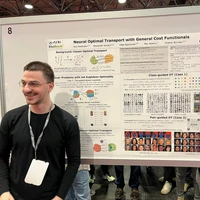
Neural Optimal Transport with General Cost Functionals
We introduce a novel neural network-based algorithm to compute optimal transport (OT) plans for general cost functionals. In contrast to common Euclidean costs, i.e., ell^1 or ell^2, such functionals provide more flexibility and allow using auxiliary information, such as class labels, to construct the required transport map. Existing methods for general costs are discrete and have limitations in practice, i.e. they do not provide an out-of-sample estimation. We address the challenge of designing a continuous OT approach for general costs that generalizes to new data points in high-dimensional spaces, such as images. Additionally, we provide the theoretical error analysis for our recovered transport plans. As an application, we construct a cost functional to map data distributions while preserving the class-wise structure.
Frame Averaging for Invariant and Equivariant Network Design
Many machine learning tasks involve learning functions that are known to be invariant or equivariant to certain symmetries of the input data. However, it is often challenging to design neural network architectures that respect these symmetries while being expressive and computationally efficient. For example, Euclidean motion invariant/equivariant graph or point cloud neural networks. We introduce Frame Averaging (FA), a general purpose and systematic framework for adapting known (backbone) architectures to become invariant or equivariant to new symmetry types. Our framework builds on the well known group averaging operator that guarantees invariance or equivariance but is intractable. In contrast, we observe that for many important classes of symmetries, this operator can be replaced with an averaging operator over a small subset of the group elements, called a frame. We show that averaging over a frame guarantees exact invariance or equivariance while often being much simpler to compute than averaging over the entire group. Furthermore, we prove that FA-based models have maximal expressive power in a broad setting and in general preserve the expressive power of their backbone architectures. Using frame averaging, we propose a new class of universal Graph Neural Networks (GNNs), universal Euclidean motion invariant point cloud networks, and Euclidean motion invariant Message Passing (MP) GNNs. We demonstrate the practical effectiveness of FA on several applications including point cloud normal estimation, beyond 2-WL graph separation, and n-body dynamics prediction, achieving state-of-the-art results in all of these benchmarks.
Efficient Sparse Spherical k-Means for Document Clustering
Spherical k-Means is frequently used to cluster document collections because it performs reasonably well in many settings and is computationally efficient. However, the time complexity increases linearly with the number of clusters k, which limits the suitability of the algorithm for larger values of k depending on the size of the collection. Optimizations targeted at the Euclidean k-Means algorithm largely do not apply because the cosine distance is not a metric. We therefore propose an efficient indexing structure to improve the scalability of Spherical k-Means with respect to k. Our approach exploits the sparsity of the input vectors and the convergence behavior of k-Means to reduce the number of comparisons on each iteration significantly.
Signal-to-Noise Ratio: A Robust Distance Metric for Deep Metric Learning
Deep metric learning, which learns discriminative features to process image clustering and retrieval tasks, has attracted extensive attention in recent years. A number of deep metric learning methods, which ensure that similar examples are mapped close to each other and dissimilar examples are mapped farther apart, have been proposed to construct effective structures for loss functions and have shown promising results. In this paper, different from the approaches on learning the loss structures, we propose a robust SNR distance metric based on Signal-to-Noise Ratio (SNR) for measuring the similarity of image pairs for deep metric learning. By exploring the properties of our SNR distance metric from the view of geometry space and statistical theory, we analyze the properties of our metric and show that it can preserve the semantic similarity between image pairs, which well justify its suitability for deep metric learning. Compared with Euclidean distance metric, our SNR distance metric can further jointly reduce the intra-class distances and enlarge the inter-class distances for learned features. Leveraging our SNR distance metric, we propose Deep SNR-based Metric Learning (DSML) to generate discriminative feature embeddings. By extensive experiments on three widely adopted benchmarks, including CARS196, CUB200-2011 and CIFAR10, our DSML has shown its superiority over other state-of-the-art methods. Additionally, we extend our SNR distance metric to deep hashing learning, and conduct experiments on two benchmarks, including CIFAR10 and NUS-WIDE, to demonstrate the effectiveness and generality of our SNR distance metric.

Sparse 3D Topological Graphs for Micro-Aerial Vehicle Planning
Micro-Aerial Vehicles (MAVs) have the advantage of moving freely in 3D space. However, creating compact and sparse map representations that can be efficiently used for planning for such robots is still an open problem. In this paper, we take maps built from noisy sensor data and construct a sparse graph containing topological information that can be used for 3D planning. We use a Euclidean Signed Distance Field, extract a 3D Generalized Voronoi Diagram (GVD), and obtain a thin skeleton diagram representing the topological structure of the environment. We then convert this skeleton diagram into a sparse graph, which we show is resistant to noise and changes in resolution. We demonstrate global planning over this graph, and the orders of magnitude speed-up it offers over other common planning methods. We validate our planning algorithm in real maps built onboard an MAV, using RGB-D sensing.
HLFormer: Enhancing Partially Relevant Video Retrieval with Hyperbolic Learning
Partially Relevant Video Retrieval (PRVR) addresses the critical challenge of matching untrimmed videos with text queries describing only partial content. Existing methods suffer from geometric distortion in Euclidean space that sometimes misrepresents the intrinsic hierarchical structure of videos and overlooks certain hierarchical semantics, ultimately leading to suboptimal temporal modeling. To address this issue, we propose the first hyperbolic modeling framework for PRVR, namely HLFormer, which leverages hyperbolic space learning to compensate for the suboptimal hierarchical modeling capabilities of Euclidean space. Specifically, HLFormer integrates the Lorentz Attention Block and Euclidean Attention Block to encode video embeddings in hybrid spaces, using the Mean-Guided Adaptive Interaction Module to dynamically fuse features. Additionally, we introduce a Partial Order Preservation Loss to enforce "text < video" hierarchy through Lorentzian cone constraints. This approach further enhances cross-modal matching by reinforcing partial relevance between video content and text queries. Extensive experiments show that HLFormer outperforms state-of-the-art methods. Code is released at https://github.com/lijun2005/ICCV25-HLFormer.

Iterate to Accelerate: A Unified Framework for Iterative Reasoning and Feedback Convergence
We introduce a unified framework for iterative reasoning that leverages non-Euclidean geometry via Bregman divergences, higher-order operator averaging, and adaptive feedback mechanisms. Our analysis establishes that, under mild smoothness and contractivity assumptions, a generalized update scheme not only unifies classical methods such as mirror descent and dynamic programming but also captures modern chain-of-thought reasoning processes in large language models. In particular, we prove that our accelerated iterative update achieves an O(1/t^2) convergence rate in the absence of persistent perturbations, and we further demonstrate that feedback (iterative) architectures are necessary to approximate certain fixed-point functions efficiently. These theoretical insights bridge classical acceleration techniques with contemporary applications in neural computation and optimization.

Scaling Riemannian Diffusion Models
Riemannian diffusion models draw inspiration from standard Euclidean space diffusion models to learn distributions on general manifolds. Unfortunately, the additional geometric complexity renders the diffusion transition term inexpressible in closed form, so prior methods resort to imprecise approximations of the score matching training objective that degrade performance and preclude applications in high dimensions. In this work, we reexamine these approximations and propose several practical improvements. Our key observation is that most relevant manifolds are symmetric spaces, which are much more amenable to computation. By leveraging and combining various ans\"{a}tze, we can quickly compute relevant quantities to high precision. On low dimensional datasets, our correction produces a noticeable improvement, allowing diffusion to compete with other methods. Additionally, we show that our method enables us to scale to high dimensional tasks on nontrivial manifolds. In particular, we model QCD densities on SU(n) lattices and contrastively learned embeddings on high dimensional hyperspheres.
SE(3) Diffusion Model-based Point Cloud Registration for Robust 6D Object Pose Estimation
In this paper, we introduce an SE(3) diffusion model-based point cloud registration framework for 6D object pose estimation in real-world scenarios. Our approach formulates the 3D registration task as a denoising diffusion process, which progressively refines the pose of the source point cloud to obtain a precise alignment with the model point cloud. Training our framework involves two operations: An SE(3) diffusion process and an SE(3) reverse process. The SE(3) diffusion process gradually perturbs the optimal rigid transformation of a pair of point clouds by continuously injecting noise (perturbation transformation). By contrast, the SE(3) reverse process focuses on learning a denoising network that refines the noisy transformation step-by-step, bringing it closer to the optimal transformation for accurate pose estimation. Unlike standard diffusion models used in linear Euclidean spaces, our diffusion model operates on the SE(3) manifold. This requires exploiting the linear Lie algebra se(3) associated with SE(3) to constrain the transformation transitions during the diffusion and reverse processes. Additionally, to effectively train our denoising network, we derive a registration-specific variational lower bound as the optimization objective for model learning. Furthermore, we show that our denoising network can be constructed with a surrogate registration model, making our approach applicable to different deep registration networks. Extensive experiments demonstrate that our diffusion registration framework presents outstanding pose estimation performance on the real-world TUD-L, LINEMOD, and Occluded-LINEMOD datasets.
A Study of Proxies for Shapley Allocations of Transport Costs
We propose and evaluate a number of solutions to the problem of calculating the cost to serve each location in a single-vehicle transport setting. Such cost to serve analysis has application both strategically and operationally in transportation. The problem is formally given by the traveling salesperson game (TSG), a cooperative total utility game in which agents correspond to locations in a traveling salesperson problem (TSP). The cost to serve a location is an allocated portion of the cost of an optimal tour. The Shapley value is one of the most important normative division schemes in cooperative games, giving a principled and fair allocation both for the TSG and more generally. We consider a number of direct and sampling-based procedures for calculating the Shapley value, and present the first proof that approximating the Shapley value of the TSG within a constant factor is NP-hard. Treating the Shapley value as an ideal baseline allocation, we then develop six proxies for that value which are relatively easy to compute. We perform an experimental evaluation using Synthetic Euclidean games as well as games derived from real-world tours calculated for fast-moving consumer goods scenarios. Our experiments show that several computationally tractable allocation techniques correspond to good proxies for the Shapley value.
Interpretable graph-based models on multimodal biomedical data integration: A technical review and benchmarking
Integrating heterogeneous biomedical data including imaging, omics, and clinical records supports accurate diagnosis and personalised care. Graph-based models fuse such non-Euclidean data by capturing spatial and relational structure, yet clinical uptake requires regulator-ready interpretability. We present the first technical survey of interpretable graph based models for multimodal biomedical data, covering 26 studies published between Jan 2019 and Sep 2024. Most target disease classification, notably cancer and rely on static graphs from simple similarity measures, while graph-native explainers are rare; post-hoc methods adapted from non-graph domains such as gradient saliency, and SHAP predominate. We group existing approaches into four interpretability families, outline trends such as graph-in-graph hierarchies, knowledge-graph edges, and dynamic topology learning, and perform a practical benchmark. Using an Alzheimer disease cohort, we compare Sensitivity Analysis, Gradient Saliency, SHAP and Graph Masking. SHAP and Sensitivity Analysis recover the broadest set of known AD pathways and Gene-Ontology terms, whereas Gradient Saliency and Graph Masking surface complementary metabolic and transport signatures. Permutation tests show all four beat random gene sets, but with distinct trade-offs: SHAP and Graph Masking offer deeper biology at higher compute cost, while Gradient Saliency and Sensitivity Analysis are quicker though coarser. We also provide a step-by-step flowchart covering graph construction, explainer choice and resource budgeting to help researchers balance transparency and performance. This review synthesises the state of interpretable graph learning for multimodal medicine, benchmarks leading techniques, and charts future directions, from advanced XAI tools to under-studied diseases, serving as a concise reference for method developers and translational scientists.
Learning to Normalize on the SPD Manifold under Bures-Wasserstein Geometry
Covariance matrices have proven highly effective across many scientific fields. Since these matrices lie within the Symmetric Positive Definite (SPD) manifold - a Riemannian space with intrinsic non-Euclidean geometry, the primary challenge in representation learning is to respect this underlying geometric structure. Drawing inspiration from the success of Euclidean deep learning, researchers have developed neural networks on the SPD manifolds for more faithful covariance embedding learning. A notable advancement in this area is the implementation of Riemannian batch normalization (RBN), which has been shown to improve the performance of SPD network models. Nonetheless, the Riemannian metric beneath the existing RBN might fail to effectively deal with the ill-conditioned SPD matrices (ICSM), undermining the effectiveness of RBN. In contrast, the Bures-Wasserstein metric (BWM) demonstrates superior performance for ill-conditioning. In addition, the recently introduced Generalized BWM (GBWM) parameterizes the vanilla BWM via an SPD matrix, allowing for a more nuanced representation of vibrant geometries of the SPD manifold. Therefore, we propose a novel RBN algorithm based on the GBW geometry, incorporating a learnable metric parameter. Moreover, the deformation of GBWM by matrix power is also introduced to further enhance the representational capacity of GBWM-based RBN. Experimental results on different datasets validate the effectiveness of our proposed method.

Metric Flow Matching for Smooth Interpolations on the Data Manifold
Matching objectives underpin the success of modern generative models and rely on constructing conditional paths that transform a source distribution into a target distribution. Despite being a fundamental building block, conditional paths have been designed principally under the assumption of Euclidean geometry, resulting in straight interpolations. However, this can be particularly restrictive for tasks such as trajectory inference, where straight paths might lie outside the data manifold, thus failing to capture the underlying dynamics giving rise to the observed marginals. In this paper, we propose Metric Flow Matching (MFM), a novel simulation-free framework for conditional flow matching where interpolants are approximate geodesics learned by minimizing the kinetic energy of a data-induced Riemannian metric. This way, the generative model matches vector fields on the data manifold, which corresponds to lower uncertainty and more meaningful interpolations. We prescribe general metrics to instantiate MFM, independent of the task, and test it on a suite of challenging problems including LiDAR navigation, unpaired image translation, and modeling cellular dynamics. We observe that MFM outperforms the Euclidean baselines, particularly achieving SOTA on single-cell trajectory prediction.
ParaFormer: Parallel Attention Transformer for Efficient Feature Matching
Heavy computation is a bottleneck limiting deep-learningbased feature matching algorithms to be applied in many realtime applications. However, existing lightweight networks optimized for Euclidean data cannot address classical feature matching tasks, since sparse keypoint based descriptors are expected to be matched. This paper tackles this problem and proposes two concepts: 1) a novel parallel attention model entitled ParaFormer and 2) a graph based U-Net architecture with attentional pooling. First, ParaFormer fuses features and keypoint positions through the concept of amplitude and phase, and integrates self- and cross-attention in a parallel manner which achieves a win-win performance in terms of accuracy and efficiency. Second, with U-Net architecture and proposed attentional pooling, the ParaFormer-U variant significantly reduces computational complexity, and minimize performance loss caused by downsampling. Sufficient experiments on various applications, including homography estimation, pose estimation, and image matching, demonstrate that ParaFormer achieves state-of-the-art performance while maintaining high efficiency. The efficient ParaFormer-U variant achieves comparable performance with less than 50% FLOPs of the existing attention-based models.
Bridging Cross-Lingual Gaps During Leveraging the Multilingual Sequence-to-Sequence Pretraining for Text Generation and Understanding
For multilingual sequence-to-sequence pretrained language models (multilingual Seq2Seq PLMs), e.g. mBART, the self-supervised pretraining task is trained on a wide range of monolingual languages, e.g. 25 languages from CommonCrawl, while the downstream cross-lingual tasks generally progress on a bilingual language subset, e.g. English-German, making there exists the data discrepancy, namely domain discrepancy, and cross-lingual learning objective discrepancy, namely task discrepancy, between the pretraining and finetuning stages. To bridge the above cross-lingual domain and task gaps, we extend the vanilla pretrain-finetune pipeline with extra code-switching restore task. Specifically, the first stage employs the self-supervised code-switching restore task as a pretext task, allowing the multilingual Seq2Seq PLMs to acquire some in-domain alignment information. And for the second stage, we fine-tune the model on downstream data normally. Experiments on both NLG evaluation (12 bilingual translation tasks, 30 zero-shot translation tasks, and 2 cross-lingual summarization tasks) and NLU evaluation (7 cross-lingual natural language inference tasks) show our model outperforms the strong baseline mBART with standard finetuning strategy, consistently. Analyses indicate our approach could narrow the Euclidean distance of cross-lingual sentence representations, and improve the model generalization with trivial computational cost. We release the code at: https://github.com/zanchangtong/CSR4mBART.


Sampling with Mirrored Stein Operators
We introduce a new family of particle evolution samplers suitable for constrained domains and non-Euclidean geometries. Stein Variational Mirror Descent and Mirrored Stein Variational Gradient Descent minimize the Kullback-Leibler (KL) divergence to constrained target distributions by evolving particles in a dual space defined by a mirror map. Stein Variational Natural Gradient exploits non-Euclidean geometry to more efficiently minimize the KL divergence to unconstrained targets. We derive these samplers from a new class of mirrored Stein operators and adaptive kernels developed in this work. We demonstrate that these new samplers yield accurate approximations to distributions on the simplex, deliver valid confidence intervals in post-selection inference, and converge more rapidly than prior methods in large-scale unconstrained posterior inference. Finally, we establish the convergence of our new procedures under verifiable conditions on the target distribution.
On Generalizations of Some Distance Based Classifiers for HDLSS Data
In high dimension, low sample size (HDLSS) settings, classifiers based on Euclidean distances like the nearest neighbor classifier and the average distance classifier perform quite poorly if differences between locations of the underlying populations get masked by scale differences. To rectify this problem, several modifications of these classifiers have been proposed in the literature. However, existing methods are confined to location and scale differences only, and often fail to discriminate among populations differing outside of the first two moments. In this article, we propose some simple transformations of these classifiers resulting into improved performance even when the underlying populations have the same location and scale. We further propose a generalization of these classifiers based on the idea of grouping of variables. The high-dimensional behavior of the proposed classifiers is studied theoretically. Numerical experiments with a variety of simulated examples as well as an extensive analysis of real data sets exhibit advantages of the proposed methods.
Convex Optimization: Algorithms and Complexity
This monograph presents the main complexity theorems in convex optimization and their corresponding algorithms. Starting from the fundamental theory of black-box optimization, the material progresses towards recent advances in structural optimization and stochastic optimization. Our presentation of black-box optimization, strongly influenced by Nesterov's seminal book and Nemirovski's lecture notes, includes the analysis of cutting plane methods, as well as (accelerated) gradient descent schemes. We also pay special attention to non-Euclidean settings (relevant algorithms include Frank-Wolfe, mirror descent, and dual averaging) and discuss their relevance in machine learning. We provide a gentle introduction to structural optimization with FISTA (to optimize a sum of a smooth and a simple non-smooth term), saddle-point mirror prox (Nemirovski's alternative to Nesterov's smoothing), and a concise description of interior point methods. In stochastic optimization we discuss stochastic gradient descent, mini-batches, random coordinate descent, and sublinear algorithms. We also briefly touch upon convex relaxation of combinatorial problems and the use of randomness to round solutions, as well as random walks based methods.

Euclid's Gift: Enhancing Spatial Perception and Reasoning in Vision-Language Models via Geometric Surrogate Tasks
Spatial intelligence spans a rich suite of abilities, including visualising and transforming shapes, mentally rotating objects, judging relational positions and containment, and estimating numerosity. However, it still remains a critical unresolved challenge for Multimodal Large Language Models (MLLMs).To fill this gap, we propose to treat Euclidean geometry problem-solving as a surrogate task. Specifically, we meticulously constructed a curated multimodal dataset, called Euclid30K, comprising approximately 30K plane and solid geometry problems. To enable the model to acquire and apply Euclidean principles from these geometry problems, we employed Group Relative Policy Optimization (GRPO) to finetune the Qwen2.5VL family and RoboBrain2.0 family, inspiring the models to identify shapes, count, and relate entities, and perform multi-step deductive reasoning using Euclidean principles. Our experiments demonstrate that the resulting models achieve substantial zero-shot gains across four spatial reasoning benchmarks (Super-CLEVR, Omni3DBench, VSI-Bench, and MindCube) without any task-specific adaptations. Notably, after training on the Euclid30K, the mean VSI-Bench accuracy of all evaluated models rose from 34.5% to 40.5%, improving by 5.5 percentage points. Among them, RoboBrain2.0-Euclid-7B achieves 49.6\% accuracy, surpassing the previous state-of-the-art model, Spatial-MLLM.To our knowledge, this is the first systematic study showing that geometry-centric fine-tuning can confer vision-language models with broadly transferable spatial skills. Code and Euclid30K dataset can be found in https://zgca-ai4edu.github.io/Euclids_Gift.

Small-Gain Nash: Certified Contraction to Nash Equilibria in Differentiable Games
Classical convergence guarantees for gradient-based learning in games require the pseudo-gradient to be (strongly) monotone in Euclidean geometry as shown by rosen(1965), a condition that often fails even in simple games with strong cross-player couplings. We introduce Small-Gain Nash (SGN), a block small-gain condition in a custom block-weighted geometry. SGN converts local curvature and cross-player Lipschitz coupling bounds into a tractable certificate of contraction. It constructs a weighted block metric in which the pseudo-gradient becomes strongly monotone on any region where these bounds hold, even when it is non-monotone in the Euclidean sense. The continuous flow is exponentially contracting in this designed geometry, and projected Euler and RK4 discretizations converge under explicit step-size bounds derived from the SGN margin and a local Lipschitz constant. Our analysis reveals a certified ``timescale band'', a non-asymptotic, metric-based certificate that plays a TTUR-like role: rather than forcing asymptotic timescale separation via vanishing, unequal step sizes, SGN identifies a finite band of relative metric weights for which a single-step-size dynamics is provably contractive. We validate the framework on quadratic games where Euclidean monotonicity analysis fails to predict convergence, but SGN successfully certifies it, and extend the construction to mirror/Fisher geometries for entropy-regularized policy gradient in Markov games. The result is an offline certification pipeline that estimates curvature, coupling, and Lipschitz parameters on compact regions, optimizes block weights to enlarge the SGN margin, and returns a structural, computable convergence certificate consisting of a metric, contraction rate, and safe step-sizes for non-monotone games.

A Comprehensive Survey on Graph Neural Networks
Deep learning has revolutionized many machine learning tasks in recent years, ranging from image classification and video processing to speech recognition and natural language understanding. The data in these tasks are typically represented in the Euclidean space. However, there is an increasing number of applications where data are generated from non-Euclidean domains and are represented as graphs with complex relationships and interdependency between objects. The complexity of graph data has imposed significant challenges on existing machine learning algorithms. Recently, many studies on extending deep learning approaches for graph data have emerged. In this survey, we provide a comprehensive overview of graph neural networks (GNNs) in data mining and machine learning fields. We propose a new taxonomy to divide the state-of-the-art graph neural networks into four categories, namely recurrent graph neural networks, convolutional graph neural networks, graph autoencoders, and spatial-temporal graph neural networks. We further discuss the applications of graph neural networks across various domains and summarize the open source codes, benchmark data sets, and model evaluation of graph neural networks. Finally, we propose potential research directions in this rapidly growing field.
A Test for Jumps in Metric-Space Conditional Means
Standard methods for detecting discontinuities in conditional means are not applicable to outcomes that are complex, non-Euclidean objects like distributions, networks, or covariance matrices. This article develops a nonparametric test for jumps in conditional means when outcomes lie in a non-Euclidean metric space. Using local Fr\'echet regressionx2014which generalizes standard regression to metric-space valued datax2014the method estimates a mean path on either side of a candidate cutoff, extending existing k-sample tests to a flexible regression setting. Key theoretical contributions include a central limit theorem for the local estimator of the conditional Fr\'echet variance and the asymptotic validity and consistency of the proposed test. Simulations confirm nominal size control and robust power in finite samples. Two applications demonstrate the method's value by revealing effects invisible to scalar-based tests. First, I detect a sharp change in work-from-home compositions at Washington State's income threshold for non-compete enforceability during COVID-19, highlighting remote work's role as a bargaining margin. Second, I find that countries restructure their input-output networks after losing preferential US trade access. These findings underscore that analyzing regression functions within their native metric spaces can reveal structural discontinuities that scalar summaries would miss.

Hyperbolic Brain Representations
Artificial neural networks (ANN) were inspired by the architecture and functions of the human brain and have revolutionised the field of artificial intelligence (AI). Inspired by studies on the latent geometry of the brain we posit that an increase in the research and application of hyperbolic geometry in machine learning will lead to increased accuracy, improved feature space representations and more efficient models across a range of tasks. We look at the structure and functions of the human brain, highlighting the alignment between the brain's hierarchical nature and hyperbolic geometry. By examining the brain's complex network of neuron connections and its cognitive processes, we illustrate how hyperbolic geometry plays a pivotal role in human intelligence. Empirical evidence indicates that hyperbolic neural networks outperform Euclidean models for tasks including natural language processing, computer vision and complex network analysis, requiring fewer parameters and exhibiting better generalisation. Despite its nascent adoption, hyperbolic geometry holds promise for improving machine learning models and advancing the field toward AGI.

Poincaré ResNet
This paper introduces an end-to-end residual network that operates entirely on the Poincar\'e ball model of hyperbolic space. Hyperbolic learning has recently shown great potential for visual understanding, but is currently only performed in the penultimate layer(s) of deep networks. All visual representations are still learned through standard Euclidean networks. In this paper we investigate how to learn hyperbolic representations of visual data directly from the pixel-level. We propose Poincar\'e ResNet, a hyperbolic counterpart of the celebrated residual network, starting from Poincar\'e 2D convolutions up to Poincar\'e residual connections. We identify three roadblocks for training convolutional networks entirely in hyperbolic space and propose a solution for each: (i) Current hyperbolic network initializations collapse to the origin, limiting their applicability in deeper networks. We provide an identity-based initialization that preserves norms over many layers. (ii) Residual networks rely heavily on batch normalization, which comes with expensive Fr\'echet mean calculations in hyperbolic space. We introduce Poincar\'e midpoint batch normalization as a faster and equally effective alternative. (iii) Due to the many intermediate operations in Poincar\'e layers, we lastly find that the computation graphs of deep learning libraries blow up, limiting our ability to train on deep hyperbolic networks. We provide manual backward derivations of core hyperbolic operations to maintain manageable computation graphs.
Spatio-Temporal Graph Neural Networks: A Survey
Graph Neural Networks have gained huge interest in the past few years. These powerful algorithms expanded deep learning models to non-Euclidean space and were able to achieve state of art performance in various applications including recommender systems and social networks. However, this performance is based on static graph structures assumption which limits the Graph Neural Networks performance when the data varies with time. Spatiotemporal Graph Neural Networks are extension of Graph Neural Networks that takes the time factor into account. Recently, various Spatiotemporal Graph Neural Network algorithms were proposed and achieved superior performance compared to other deep learning algorithms in several time dependent applications. This survey discusses interesting topics related to Spatiotemporal Graph Neural Networks, including algorithms, applications, and open challenges.

Contracting Skeletal Kinematics for Human-Related Video Anomaly Detection
Detecting the anomaly of human behavior is paramount to timely recognizing endangering situations, such as street fights or elderly falls. However, anomaly detection is complex since anomalous events are rare and because it is an open set recognition task, i.e., what is anomalous at inference has not been observed at training. We propose COSKAD, a novel model that encodes skeletal human motion by a graph convolutional network and learns to COntract SKeletal kinematic embeddings onto a latent hypersphere of minimum volume for Video Anomaly Detection. We propose three latent spaces: the commonly-adopted Euclidean and the novel spherical and hyperbolic. All variants outperform the state-of-the-art on the most recent UBnormal dataset, for which we contribute a human-related version with annotated skeletons. COSKAD sets a new state-of-the-art on the human-related versions of ShanghaiTech Campus and CUHK Avenue, with performance comparable to video-based methods. Source code and dataset will be released upon acceptance.


BQ-NCO: Bisimulation Quotienting for Efficient Neural Combinatorial Optimization
Despite the success of neural-based combinatorial optimization methods for end-to-end heuristic learning, out-of-distribution generalization remains a challenge. In this paper, we present a novel formulation of Combinatorial Optimization Problems (COPs) as Markov Decision Processes (MDPs) that effectively leverages common symmetries of COPs to improve out-of-distribution robustness. Starting from a direct MDP formulation of a constructive method, we introduce a generic way to reduce the state space, based on Bisimulation Quotienting (BQ) in MDPs. Then, for COPs with a recursive nature, we specialize the bisimulation and show how the reduced state exploits the symmetries of these problems and facilitates MDP solving. Our approach is principled and we prove that an optimal policy for the proposed BQ-MDP actually solves the associated COPs. We illustrate our approach on five classical problems: the Euclidean and Asymmetric Traveling Salesman, Capacitated Vehicle Routing, Orienteering and Knapsack Problems. Furthermore, for each problem, we introduce a simple attention-based policy network for the BQ-MDPs, which we train by imitation of (near) optimal solutions of small instances from a single distribution. We obtain new state-of-the-art results for the five COPs on both synthetic and realistic benchmarks. Notably, in contrast to most existing neural approaches, our learned policies show excellent generalization performance to much larger instances than seen during training, without any additional search procedure.

Riemannian Score-Based Generative Modelling
Score-based generative models (SGMs) are a powerful class of generative models that exhibit remarkable empirical performance. Score-based generative modelling (SGM) consists of a ``noising'' stage, whereby a diffusion is used to gradually add Gaussian noise to data, and a generative model, which entails a ``denoising'' process defined by approximating the time-reversal of the diffusion. Existing SGMs assume that data is supported on a Euclidean space, i.e. a manifold with flat geometry. In many domains such as robotics, geoscience or protein modelling, data is often naturally described by distributions living on Riemannian manifolds and current SGM techniques are not appropriate. We introduce here Riemannian Score-based Generative Models (RSGMs), a class of generative models extending SGMs to Riemannian manifolds. We demonstrate our approach on a variety of manifolds, and in particular with earth and climate science spherical data.
Riemannian Adaptive Optimization Methods
Several first order stochastic optimization methods commonly used in the Euclidean domain such as stochastic gradient descent (SGD), accelerated gradient descent or variance reduced methods have already been adapted to certain Riemannian settings. However, some of the most popular of these optimization tools - namely Adam , Adagrad and the more recent Amsgrad - remain to be generalized to Riemannian manifolds. We discuss the difficulty of generalizing such adaptive schemes to the most agnostic Riemannian setting, and then provide algorithms and convergence proofs for geodesically convex objectives in the particular case of a product of Riemannian manifolds, in which adaptivity is implemented across manifolds in the cartesian product. Our generalization is tight in the sense that choosing the Euclidean space as Riemannian manifold yields the same algorithms and regret bounds as those that were already known for the standard algorithms. Experimentally, we show faster convergence and to a lower train loss value for Riemannian adaptive methods over their corresponding baselines on the realistic task of embedding the WordNet taxonomy in the Poincare ball.
Poincaré Embeddings for Learning Hierarchical Representations
Representation learning has become an invaluable approach for learning from symbolic data such as text and graphs. However, while complex symbolic datasets often exhibit a latent hierarchical structure, state-of-the-art methods typically learn embeddings in Euclidean vector spaces, which do not account for this property. For this purpose, we introduce a new approach for learning hierarchical representations of symbolic data by embedding them into hyperbolic space -- or more precisely into an n-dimensional Poincar\'e ball. Due to the underlying hyperbolic geometry, this allows us to learn parsimonious representations of symbolic data by simultaneously capturing hierarchy and similarity. We introduce an efficient algorithm to learn the embeddings based on Riemannian optimization and show experimentally that Poincar\'e embeddings outperform Euclidean embeddings significantly on data with latent hierarchies, both in terms of representation capacity and in terms of generalization ability.
CAT: Curvature-Adaptive Transformers for Geometry-Aware Learning
Transformers achieve strong performance across diverse domains but implicitly assume Euclidean geometry in their attention mechanisms, limiting their effectiveness on data with non-Euclidean structure. While recent extensions to hyperbolic and spherical spaces show promise for hierarchical and cyclical patterns, respectively, they require committing to a single geometry a priori, reducing flexibility when data exhibits mixed geometric properties. We introduce the Curvature-Adaptive Transformer (CAT), a novel architecture that dynamically learns per-token routing across three geometric attention branches through a lightweight, differentiable gating mechanism. Unlike fixed-geometry approaches, CAT enables adaptive geometric specialization, routing tokens to the appropriate curvature based on their local relational structure. The routing network provides interpretable curvature preferences while each branch employs geometry-specific operations optimized for its respective manifold. On knowledge graph completion benchmarks (FB15k-237, WN18RR), CAT achieves approximately 10% improvements in MRR and Hits@10 over fixed-geometry baselines with minimal overhead (5% parameter increase, comparable inference time). These results demonstrate that learned geometric adaptation outperforms any single fixed geometry for complex relational reasoning, establishing CAT as a scalable and interpretable foundation for mixture-of-geometry architectures across language, vision, and multimodal domains.
Unsupervised Anomaly Detection for Autonomous Robots via Mahalanobis SVDD with Audio-IMU Fusion
Reliable anomaly detection is essential for ensuring the safety of autonomous robots, particularly when conventional detection systems based on vision or LiDAR become unreliable in adverse or unpredictable conditions. In such scenarios, alternative sensing modalities are needed to provide timely and robust feedback. To this end, we explore the use of audio and inertial measurement unit (IMU) sensors to detect underlying anomalies in autonomous mobile robots, such as collisions and internal mechanical faults. Furthermore, to address the challenge of limited labeled anomaly data, we propose an unsupervised anomaly detection framework based on Mahalanobis Support Vector Data Description (M-SVDD). In contrast to conventional SVDD methods that rely on Euclidean distance and assume isotropic feature distributions, our approach employs the Mahalanobis distance to adaptively scale feature dimensions and capture inter-feature correlations, enabling more expressive decision boundaries. In addition, a reconstruction-based auxiliary branch is introduced to preserve feature diversity and prevent representation collapse, further enhancing the robustness of anomaly detection. Extensive experiments on a collected mobile robot dataset and four public datasets demonstrate the effectiveness of the proposed method, as shown in the video https://youtu.be/yh1tn6DDD4A. Code and dataset are available at https://github.com/jamesyang7/M-SVDD.
Direction-Aware Diagonal Autoregressive Image Generation
The raster-ordered image token sequence exhibits a significant Euclidean distance between index-adjacent tokens at line breaks, making it unsuitable for autoregressive generation. To address this issue, this paper proposes Direction-Aware Diagonal Autoregressive Image Generation (DAR) method, which generates image tokens following a diagonal scanning order. The proposed diagonal scanning order ensures that tokens with adjacent indices remain in close proximity while enabling causal attention to gather information from a broader range of directions. Additionally, two direction-aware modules: 4D-RoPE and direction embeddings are introduced, enhancing the model's capability to handle frequent changes in generation direction. To leverage the representational capacity of the image tokenizer, we use its codebook as the image token embeddings. We propose models of varying scales, ranging from 485M to 2.0B. On the 256times256 ImageNet benchmark, our DAR-XL (2.0B) outperforms all previous autoregressive image generators, achieving a state-of-the-art FID score of 1.37.
Fréchet Cumulative Covariance Net for Deep Nonlinear Sufficient Dimension Reduction with Random Objects
Nonlinear sufficient dimension reductionlibing_generalSDR, which constructs nonlinear low-dimensional representations to summarize essential features of high-dimensional data, is an important branch of representation learning. However, most existing methods are not applicable when the response variables are complex non-Euclidean random objects, which are frequently encountered in many recent statistical applications. In this paper, we introduce a new statistical dependence measure termed Fr\'echet Cumulative Covariance (FCCov) and develop a novel nonlinear SDR framework based on FCCov. Our approach is not only applicable to complex non-Euclidean data, but also exhibits robustness against outliers. We further incorporate Feedforward Neural Networks (FNNs) and Convolutional Neural Networks (CNNs) to estimate nonlinear sufficient directions in the sample level. Theoretically, we prove that our method with squared Frobenius norm regularization achieves unbiasedness at the sigma-field level. Furthermore, we establish non-asymptotic convergence rates for our estimators based on FNNs and ResNet-type CNNs, which match the minimax rate of nonparametric regression up to logarithmic factors. Intensive simulation studies verify the performance of our methods in both Euclidean and non-Euclidean settings. We apply our method to facial expression recognition datasets and the results underscore more realistic and broader applicability of our proposal.
On Space Folds of ReLU Neural Networks
Recent findings suggest that the consecutive layers of ReLU neural networks can be understood geometrically as space folding transformations of the input space, revealing patterns of self-similarity. In this paper, we present the first quantitative analysis of this space folding phenomenon in ReLU neural networks. Our approach focuses on examining how straight paths in the Euclidean input space are mapped to their counterparts in the Hamming activation space. In this process, the convexity of straight lines is generally lost, giving rise to non-convex folding behavior. To quantify this effect, we introduce a novel measure based on range metrics, similar to those used in the study of random walks, and provide the proof for the equivalence of convexity notions between the input and activation spaces. Furthermore, we provide empirical analysis on a geometrical analysis benchmark (CantorNet) as well as an image classification benchmark (MNIST). Our work advances the understanding of the activation space in ReLU neural networks by leveraging the phenomena of geometric folding, providing valuable insights on how these models process input information.

Proposing and solving olympiad geometry with guided tree search
Mathematics olympiads are prestigious competitions, with problem proposing and solving highly honored. Building artificial intelligence that proposes and solves olympiads presents an unresolved challenge in automated theorem discovery and proving, especially in geometry for its combination of numerical and spatial elements. We introduce TongGeometry, a Euclidean geometry system supporting tree-search-based guided problem proposing and solving. The efficient geometry system establishes the most extensive repository of geometry theorems to date: within the same computational budget as the existing state-of-the-art, TongGeometry discovers 6.7 billion geometry theorems requiring auxiliary constructions, including 4.1 billion exhibiting geometric symmetry. Among them, 10 theorems were proposed to regional mathematical olympiads with 3 of TongGeometry's proposals selected in real competitions, earning spots in a national team qualifying exam or a top civil olympiad in China and the US. Guided by fine-tuned large language models, TongGeometry solved all International Mathematical Olympiad geometry in IMO-AG-30, outperforming gold medalists for the first time. It also surpasses the existing state-of-the-art across a broader spectrum of olympiad-level problems. The full capabilities of the system can be utilized on a consumer-grade machine, making the model more accessible and fostering widespread democratization of its use. By analogy, unlike existing systems that merely solve problems like students, TongGeometry acts like a geometry coach, discovering, presenting, and proving theorems.
Hyp-OC: Hyperbolic One Class Classification for Face Anti-Spoofing
Face recognition technology has become an integral part of modern security systems and user authentication processes. However, these systems are vulnerable to spoofing attacks and can easily be circumvented. Most prior research in face anti-spoofing (FAS) approaches it as a two-class classification task where models are trained on real samples and known spoof attacks and tested for detection performance on unknown spoof attacks. However, in practice, FAS should be treated as a one-class classification task where, while training, one cannot assume any knowledge regarding the spoof samples a priori. In this paper, we reformulate the face anti-spoofing task from a one-class perspective and propose a novel hyperbolic one-class classification framework. To train our network, we use a pseudo-negative class sampled from the Gaussian distribution with a weighted running mean and propose two novel loss functions: (1) Hyp-PC: Hyperbolic Pairwise Confusion loss, and (2) Hyp-CE: Hyperbolic Cross Entropy loss, which operate in the hyperbolic space. Additionally, we employ Euclidean feature clipping and gradient clipping to stabilize the training in the hyperbolic space. To the best of our knowledge, this is the first work extending hyperbolic embeddings for face anti-spoofing in a one-class manner. With extensive experiments on five benchmark datasets: Rose-Youtu, MSU-MFSD, CASIA-MFSD, Idiap Replay-Attack, and OULU-NPU, we demonstrate that our method significantly outperforms the state-of-the-art, achieving better spoof detection performance.

Inverse distance weighting attention
We report the effects of replacing the scaled dot-product (within softmax) attention with the negative-log of Euclidean distance. This form of attention simplifies to inverse distance weighting interpolation. Used in simple one hidden layer networks and trained with vanilla cross-entropy loss on classification problems, it tends to produce a key matrix containing prototypes and a value matrix with corresponding logits. We also show that the resulting interpretable networks can be augmented with manually-constructed prototypes to perform low-impact handling of special cases.

LCOT: Linear circular optimal transport
The optimal transport problem for measures supported on non-Euclidean spaces has recently gained ample interest in diverse applications involving representation learning. In this paper, we focus on circular probability measures, i.e., probability measures supported on the unit circle, and introduce a new computationally efficient metric for these measures, denoted as Linear Circular Optimal Transport (LCOT). The proposed metric comes with an explicit linear embedding that allows one to apply Machine Learning (ML) algorithms to the embedded measures and seamlessly modify the underlying metric for the ML algorithm to LCOT. We show that the proposed metric is rooted in the Circular Optimal Transport (COT) and can be considered the linearization of the COT metric with respect to a fixed reference measure. We provide a theoretical analysis of the proposed metric and derive the computational complexities for pairwise comparison of circular probability measures. Lastly, through a set of numerical experiments, we demonstrate the benefits of LCOT in learning representations of circular measures.


Implicit Neural Representations and the Algebra of Complex Wavelets
Implicit neural representations (INRs) have arisen as useful methods for representing signals on Euclidean domains. By parameterizing an image as a multilayer perceptron (MLP) on Euclidean space, INRs effectively represent signals in a way that couples spatial and spectral features of the signal that is not obvious in the usual discrete representation, paving the way for continuous signal processing and machine learning approaches that were not previously possible. Although INRs using sinusoidal activation functions have been studied in terms of Fourier theory, recent works have shown the advantage of using wavelets instead of sinusoids as activation functions, due to their ability to simultaneously localize in both frequency and space. In this work, we approach such INRs and demonstrate how they resolve high-frequency features of signals from coarse approximations done in the first layer of the MLP. This leads to multiple prescriptions for the design of INR architectures, including the use of complex wavelets, decoupling of low and band-pass approximations, and initialization schemes based on the singularities of the desired signal.
Unsupervised Deep Probabilistic Approach for Partial Point Cloud Registration
Deep point cloud registration methods face challenges to partial overlaps and rely on labeled data. To address these issues, we propose UDPReg, an unsupervised deep probabilistic registration framework for point clouds with partial overlaps. Specifically, we first adopt a network to learn posterior probability distributions of Gaussian mixture models (GMMs) from point clouds. To handle partial point cloud registration, we apply the Sinkhorn algorithm to predict the distribution-level correspondences under the constraint of the mixing weights of GMMs. To enable unsupervised learning, we design three distribution consistency-based losses: self-consistency, cross-consistency, and local contrastive. The self-consistency loss is formulated by encouraging GMMs in Euclidean and feature spaces to share identical posterior distributions. The cross-consistency loss derives from the fact that the points of two partially overlapping point clouds belonging to the same clusters share the cluster centroids. The cross-consistency loss allows the network to flexibly learn a transformation-invariant posterior distribution of two aligned point clouds. The local contrastive loss facilitates the network to extract discriminative local features. Our UDPReg achieves competitive performance on the 3DMatch/3DLoMatch and ModelNet/ModelLoNet benchmarks.
Mathematical Justification of Hard Negative Mining via Isometric Approximation Theorem
In deep metric learning, the Triplet Loss has emerged as a popular method to learn many computer vision and natural language processing tasks such as facial recognition, object detection, and visual-semantic embeddings. One issue that plagues the Triplet Loss is network collapse, an undesirable phenomenon where the network projects the embeddings of all data onto a single point. Researchers predominately solve this problem by using triplet mining strategies. While hard negative mining is the most effective of these strategies, existing formulations lack strong theoretical justification for their empirical success. In this paper, we utilize the mathematical theory of isometric approximation to show an equivalence between the Triplet Loss sampled by hard negative mining and an optimization problem that minimizes a Hausdorff-like distance between the neural network and its ideal counterpart function. This provides the theoretical justifications for hard negative mining's empirical efficacy. In addition, our novel application of the isometric approximation theorem provides the groundwork for future forms of hard negative mining that avoid network collapse. Our theory can also be extended to analyze other Euclidean space-based metric learning methods like Ladder Loss or Contrastive Learning.
Extending Bootstrap AMG for Clustering of Attributed Graphs
In this paper we propose a new approach to detect clusters in undirected graphs with attributed vertices. We incorporate structural and attribute similarities between the vertices in an augmented graph by creating additional vertices and edges as proposed in [1, 2]. The augmented graph is then embedded in a Euclidean space associated to its Laplacian and we cluster vertices via a modified K-means algorithm, using a new vector-valued distance in the embedding space. Main novelty of our method, which can be classified as an early fusion method, i.e., a method in which additional information on vertices are fused to the structure information before applying clustering, is the interpretation of attributes as new realizations of graph vertices, which can be dealt with as coordinate vectors in a related Euclidean space. This allows us to extend a scalable generalized spectral clustering procedure which substitutes graph Laplacian eigenvectors with some vectors, named algebraically smooth vectors, obtained by a linear-time complexity Algebraic MultiGrid (AMG) method. We discuss the performance of our proposed clustering method by comparison with recent literature approaches and public available results. Extensive experiments on different types of synthetic datasets and real-world attributed graphs show that our new algorithm, embedding attributes information in the clustering, outperforms structure-only-based methods, when the attributed network has an ambiguous structure. Furthermore, our new method largely outperforms the method which originally proposed the graph augmentation, showing that our embedding strategy and vector-valued distance are very effective in taking advantages from the augmented-graph representation.
Steerable 3D Spherical Neurons
Emerging from low-level vision theory, steerable filters found their counterpart in prior work on steerable convolutional neural networks equivariant to rigid transformations. In our work, we propose a steerable feed-forward learning-based approach that consists of neurons with spherical decision surfaces and operates on point clouds. Such spherical neurons are obtained by conformal embedding of Euclidean space and have recently been revisited in the context of learning representations of point sets. Focusing on 3D geometry, we exploit the isometry property of spherical neurons and derive a 3D steerability constraint. After training spherical neurons to classify point clouds in a canonical orientation, we use a tetrahedron basis to quadruplicate the neurons and construct rotation-equivariant spherical filter banks. We then apply the derived constraint to interpolate the filter bank outputs and, thus, obtain a rotation-invariant network. Finally, we use a synthetic point set and real-world 3D skeleton data to verify our theoretical findings. The code is available at https://github.com/pavlo-melnyk/steerable-3d-neurons.
Weighting vectors for machine learning: numerical harmonic analysis applied to boundary detection
Metric space magnitude, an active field of research in algebraic topology, is a scalar quantity that summarizes the effective number of distinct points that live in a general metric space. The {\em weighting vector} is a closely-related concept that captures, in a nontrivial way, much of the underlying geometry of the original metric space. Recent work has demonstrated that when the metric space is Euclidean, the weighting vector serves as an effective tool for boundary detection. We recast this result and show the weighting vector may be viewed as a solution to a kernelized SVM. As one consequence, we apply this new insight to the task of outlier detection, and we demonstrate performance that is competitive or exceeds performance of state-of-the-art techniques on benchmark data sets. Under mild assumptions, we show the weighting vector, which has computational cost of matrix inversion, can be efficiently approximated in linear time. We show how nearest neighbor methods can approximate solutions to the minimization problems defined by SVMs.

FisheyeDistanceNet: Self-Supervised Scale-Aware Distance Estimation using Monocular Fisheye Camera for Autonomous Driving
Fisheye cameras are commonly used in applications like autonomous driving and surveillance to provide a large field of view (>180^{circ}). However, they come at the cost of strong non-linear distortions which require more complex algorithms. In this paper, we explore Euclidean distance estimation on fisheye cameras for automotive scenes. Obtaining accurate and dense depth supervision is difficult in practice, but self-supervised learning approaches show promising results and could potentially overcome the problem. We present a novel self-supervised scale-aware framework for learning Euclidean distance and ego-motion from raw monocular fisheye videos without applying rectification. While it is possible to perform piece-wise linear approximation of fisheye projection surface and apply standard rectilinear models, it has its own set of issues like re-sampling distortion and discontinuities in transition regions. To encourage further research in this area, we will release our dataset as part of the WoodScape project yogamani2019woodscape. We further evaluated the proposed algorithm on the KITTI dataset and obtained state-of-the-art results comparable to other self-supervised monocular methods. Qualitative results on an unseen fisheye video demonstrate impressive performance https://youtu.be/Sgq1WzoOmXg.
Approximating the Convex Hull via Metric Space Magnitude
Magnitude of a finite metric space and the related notion of magnitude functions on metric spaces is an active area of research in algebraic topology. Magnitude originally arose in the context of biology, where it represents the number of effective species in an environment; when applied to a one-parameter family of metric spaces tX with scale parameter t, the magnitude captures much of the underlying geometry of the space. Prior work has mostly focussed on properties of magnitude in a global sense; in this paper we restrict the sets to finite subsets of Euclidean space and investigate its individual components. We give an explicit formula for the corrected inclusion-exclusion principle, and define a quantity associated with each point, called the moment which gives an intrinsic ordering to the points. We exploit this in order to form an algorithm which approximates the convex hull.
GraphNAS: Graph Neural Architecture Search with Reinforcement Learning
Graph Neural Networks (GNNs) have been popularly used for analyzing non-Euclidean data such as social network data and biological data. Despite their success, the design of graph neural networks requires a lot of manual work and domain knowledge. In this paper, we propose a Graph Neural Architecture Search method (GraphNAS for short) that enables automatic search of the best graph neural architecture based on reinforcement learning. Specifically, GraphNAS first uses a recurrent network to generate variable-length strings that describe the architectures of graph neural networks, and then trains the recurrent network with reinforcement learning to maximize the expected accuracy of the generated architectures on a validation data set. Extensive experimental results on node classification tasks in both transductive and inductive learning settings demonstrate that GraphNAS can achieve consistently better performance on the Cora, Citeseer, Pubmed citation network, and protein-protein interaction network. On node classification tasks, GraphNAS can design a novel network architecture that rivals the best human-invented architecture in terms of test set accuracy.
A robust, low-cost approach to Face Detection and Face Recognition
In the domain of Biometrics, recognition systems based on iris, fingerprint or palm print scans etc. are often considered more dependable due to extremely low variance in the properties of these entities with respect to time. However, over the last decade data processing capability of computers has increased manifold, which has made real-time video content analysis possible. This shows that the need of the hour is a robust and highly automated Face Detection and Recognition algorithm with credible accuracy rate. The proposed Face Detection and Recognition system using Discrete Wavelet Transform (DWT) accepts face frames as input from a database containing images from low cost devices such as VGA cameras, webcams or even CCTV's, where image quality is inferior. Face region is then detected using properties of L*a*b* color space and only Frontal Face is extracted such that all additional background is eliminated. Further, this extracted image is converted to grayscale and its dimensions are resized to 128 x 128 pixels. DWT is then applied to entire image to obtain the coefficients. Recognition is carried out by comparison of the DWT coefficients belonging to the test image with those of the registered reference image. On comparison, Euclidean distance classifier is deployed to validate the test image from the database. Accuracy for various levels of DWT Decomposition is obtained and hence, compared.

Geometry of Sample Spaces
In statistics, independent, identically distributed random samples do not carry a natural ordering, and their statistics are typically invariant with respect to permutations of their order. Thus, an n-sample in a space M can be considered as an element of the quotient space of M^n modulo the permutation group. The present paper takes this definition of sample space and the related concept of orbit types as a starting point for developing a geometric perspective on statistics. We aim at deriving a general mathematical setting for studying the behavior of empirical and population means in spaces ranging from smooth Riemannian manifolds to general stratified spaces. We fully describe the orbifold and path-metric structure of the sample space when M is a manifold or path-metric space, respectively. These results are non-trivial even when M is Euclidean. We show that the infinite sample space exists in a Gromov-Hausdorff type sense and coincides with the Wasserstein space of probability distributions on M. We exhibit Fr\'echet means and k-means as metric projections onto 1-skeleta or k-skeleta in Wasserstein space, and we define a new and more general notion of polymeans. This geometric characterization via metric projections applies equally to sample and population means, and we use it to establish asymptotic properties of polymeans such as consistency and asymptotic normality.
Mapping 1,000+ Language Models via the Log-Likelihood Vector
To compare autoregressive language models at scale, we propose using log-likelihood vectors computed on a predefined text set as model features. This approach has a solid theoretical basis: when treated as model coordinates, their squared Euclidean distance approximates the Kullback-Leibler divergence of text-generation probabilities. Our method is highly scalable, with computational cost growing linearly in both the number of models and text samples, and is easy to implement as the required features are derived from cross-entropy loss. Applying this method to over 1,000 language models, we constructed a "model map," providing a new perspective on large-scale model analysis.



Generative AI meets 3D: A Survey on Text-to-3D in AIGC Era
Generative AI (AIGC, a.k.a. AI generated content) has made remarkable progress in the past few years, among which text-guided content generation is the most practical one since it enables the interaction between human instruction and AIGC. Due to the development in text-to-image as well 3D modeling technologies (like NeRF), text-to-3D has become a newly emerging yet highly active research field. Our work conducts the first yet comprehensive survey on text-to-3D to help readers interested in this direction quickly catch up with its fast development. First, we introduce 3D data representations, including both Euclidean data and non-Euclidean data. On top of that, we introduce various foundation technologies as well as summarize how recent works combine those foundation technologies to realize satisfactory text-to-3D. Moreover, we summarize how text-to-3D technology is used in various applications, including avatar generation, texture generation, shape transformation, and scene generation.

vMFCoOp: Towards Equilibrium on a Unified Hyperspherical Manifold for Prompting Biomedical VLMs
Recent advances in context optimization (CoOp) guided by large language model (LLM)-distilled medical semantic priors offer a scalable alternative to manual prompt engineering and full fine-tuning for adapting biomedical CLIP-based vision-language models (VLMs). However, prompt learning in this context is challenged by semantic misalignment between LLMs and CLIP variants due to divergent training corpora and model architectures; it further lacks scalability across continuously evolving families of foundation models. More critically, pairwise multimodal alignment via conventional Euclidean-space optimization lacks the capacity to model unified representations or apply localized geometric constraints, which tends to amplify modality gaps in complex biomedical imaging and destabilize few-shot adaptation. In this work, we propose vMFCoOp, a framework that inversely estimates von Mises-Fisher (vMF) distributions on a shared Hyperspherical Manifold, aligning semantic biases between arbitrary LLMs and CLIP backbones via Unified Semantic Anchors to achieve robust biomedical prompting and superior few-shot classification. Grounded in three complementary constraints, vMFCoOp demonstrates consistent improvements across 14 medical datasets, 12 medical imaging modalities, and 13 anatomical regions, outperforming state-of-the-art methods in accuracy, generalization, and clinical applicability. This work aims to continuously expand to encompass more downstream applications, and the corresponding resources are intended to be shared through https://github.com/VinyehShaw/UniEqui.
On the Expressive Power of Geometric Graph Neural Networks
The expressive power of Graph Neural Networks (GNNs) has been studied extensively through the Weisfeiler-Leman (WL) graph isomorphism test. However, standard GNNs and the WL framework are inapplicable for geometric graphs embedded in Euclidean space, such as biomolecules, materials, and other physical systems. In this work, we propose a geometric version of the WL test (GWL) for discriminating geometric graphs while respecting the underlying physical symmetries: permutations, rotation, reflection, and translation. We use GWL to characterise the expressive power of geometric GNNs that are invariant or equivariant to physical symmetries in terms of distinguishing geometric graphs. GWL unpacks how key design choices influence geometric GNN expressivity: (1) Invariant layers have limited expressivity as they cannot distinguish one-hop identical geometric graphs; (2) Equivariant layers distinguish a larger class of graphs by propagating geometric information beyond local neighbourhoods; (3) Higher order tensors and scalarisation enable maximally powerful geometric GNNs; and (4) GWL's discrimination-based perspective is equivalent to universal approximation. Synthetic experiments supplementing our results are available at https://github.com/chaitjo/geometric-gnn-dojo
Equivariant Diffusion for Molecule Generation in 3D
This work introduces a diffusion model for molecule generation in 3D that is equivariant to Euclidean transformations. Our E(3) Equivariant Diffusion Model (EDM) learns to denoise a diffusion process with an equivariant network that jointly operates on both continuous (atom coordinates) and categorical features (atom types). In addition, we provide a probabilistic analysis which admits likelihood computation of molecules using our model. Experimentally, the proposed method significantly outperforms previous 3D molecular generative methods regarding the quality of generated samples and efficiency at training time.
Exploring Quantum Spacetime with Topological Data Analysis
In a novel application of the tools of topological data analysis (TDA) to nonperturbative quantum gravity, we introduce a new class of observables that allows us to assess whether quantum spacetime really resembles a ``quantum foam" near the Planck scale. The key idea is to investigate the Betti numbers of coarse-grained path integral histories, regularized in terms of dynamical triangulations, as a function of the coarse-graining scale. In two dimensions our analysis exhibits the well-known fractal structure of Euclidean quantum gravity.
GenesisGeo: Technical Report
We present GenesisGeo, an automated theorem prover in Euclidean geometry. We have open-sourced a large-scale geometry dataset of 21.8 million geometric problems, over 3 million of which contain auxiliary constructions. Specially, we significantly accelerate the symbolic deduction engine DDARN by 120x through theorem matching, combined with a C++ implementation of its core components. Furthermore, we build our neuro-symbolic prover, GenesisGeo, upon Qwen3-0.6B-Base, which solves 24 of 30 problems (IMO silver medal level) in the IMO-AG-30 benchmark using a single model, and achieves 26 problems (IMO gold medal level) with a dual-model ensemble.
Hyperbolic Large Language Models
Large language models (LLMs) have achieved remarkable success and demonstrated superior performance across various tasks, including natural language processing (NLP), weather forecasting, biological protein folding, text generation, and solving mathematical problems. However, many real-world data exhibit highly non-Euclidean latent hierarchical anatomy, such as protein networks, transportation networks, financial networks, brain networks, and linguistic structures or syntactic trees in natural languages. Effectively learning intrinsic semantic entailment and hierarchical relationships from these raw, unstructured input data using LLMs remains an underexplored area. Due to its effectiveness in modeling tree-like hierarchical structures, hyperbolic geometry -- a non-Euclidean space -- has rapidly gained popularity as an expressive latent representation space for complex data modeling across domains such as graphs, images, languages, and multi-modal data. Here, we provide a comprehensive and contextual exposition of recent advancements in LLMs that leverage hyperbolic geometry as a representation space to enhance semantic representation learning and multi-scale reasoning. Specifically, the paper presents a taxonomy of the principal techniques of Hyperbolic LLMs (HypLLMs) in terms of four main categories: (1) hyperbolic LLMs through exp/log maps; (2) hyperbolic fine-tuned models; (3) fully hyperbolic LLMs, and (4) hyperbolic state-space models. We also explore crucial potential applications and outline future research directions. A repository of key papers, models, datasets, and code implementations is available at https://github.com/sarangp2402/Hyperbolic-LLM-Models/tree/main.
Finsler Metric Clustering in Weighted Projective Spaces
This paper develops a hierarchical clustering algorithm for weighted projective spaces P_{q}, utilizing a Finsler metric d_F([z], [w]) and its rational analogue d_{F,Q}([z], [w]) to define distances that preserve the non-Euclidean geometry of these quotient manifolds. Defined via geodesic integrals of a scaling invariant Finsler norm weighted by the grades q = (q_0, q_1, dots, q_n), these metrics satisfy true metric properties including the triangle inequality, overcoming the limitations of the non-metric dissimilarity measure from prior work.
Bubbles in a box: Eliminating edge nucleation in cold-atom simulators of vacuum decay
The decay of metastable 'false vacuum' states via bubble nucleation plays a crucial role in many cosmological scenarios. Cold-atom analog experiments will soon provide the first empirical probes of this process, with potentially far-reaching implications for early-Universe cosmology and high-energy physics. However, an inevitable difference between these analog systems and the early Universe is that the former have a boundary. We show, using a combination of Euclidean calculations and real-time lattice simulations, that these boundaries generically cause rapid bubble nucleation on the edge of the experiment, obscuring the bulk nucleation that is relevant for cosmology. We demonstrate that implementing a high-density 'trench' region at the boundary completely eliminates this problem, and recovers the desired cosmological behavior. Our findings are relevant for ongoing efforts to probe vacuum decay in the laboratory, providing a practical solution to a key experimental obstacle.
Fluctuations of the connectivity threshold and largest nearest-neighbour link
Consider a random uniform sample of n points in a compact region A of Euclidean d-space, d geq 2, with a smooth or (when d=2) polygonal boundary. Fix k bf N. Let T_{n,k} be the threshold r at which the geometric graph on these n vertices with distance parameter r becomes k-connected. We show that if d=2 then n (pi/|A|) T_{n,1}^2 - log n is asymptotically standard Gumbel. For (d,k) neq (2,1), it is n (theta_d/|A|) T_{n,k}^d - (2-2/d) log n - (4-2k-2/d) log log n that converges in distribution to a nondegenerate limit, where theta_d is the volume of the unit ball. The limit is Gumbel with scale parameter 2 except when (d,k)=(2,2) where the limit is two component extreme value distributed. The different cases reflect the fact that boundary effects are more more important in some cases than others. We also give similar results for the largest k-nearest neighbour link U_{n,k} in the sample, and show T_{n,k}=U_{n,k} with high probability. We provide estimates on rates of convergence and give similar results for Poisson samples in A. Finally, we give similar results even for non-uniform samples, with a less explicit sequence of centring constants.
Hyperbolic Geometric Latent Diffusion Model for Graph Generation
Diffusion models have made significant contributions to computer vision, sparking a growing interest in the community recently regarding the application of them to graph generation. Existing discrete graph diffusion models exhibit heightened computational complexity and diminished training efficiency. A preferable and natural way is to directly diffuse the graph within the latent space. However, due to the non-Euclidean structure of graphs is not isotropic in the latent space, the existing latent diffusion models effectively make it difficult to capture and preserve the topological information of graphs. To address the above challenges, we propose a novel geometrically latent diffusion framework HypDiff. Specifically, we first establish a geometrically latent space with interpretability measures based on hyperbolic geometry, to define anisotropic latent diffusion processes for graphs. Then, we propose a geometrically latent diffusion process that is constrained by both radial and angular geometric properties, thereby ensuring the preservation of the original topological properties in the generative graphs. Extensive experimental results demonstrate the superior effectiveness of HypDiff for graph generation with various topologies.
Approximately Piecewise E(3) Equivariant Point Networks
Integrating a notion of symmetry into point cloud neural networks is a provably effective way to improve their generalization capability. Of particular interest are E(3) equivariant point cloud networks where Euclidean transformations applied to the inputs are preserved in the outputs. Recent efforts aim to extend networks that are E(3) equivariant, to accommodate inputs made of multiple parts, each of which exhibits local E(3) symmetry. In practical settings, however, the partitioning into individually transforming regions is unknown a priori. Errors in the partition prediction would unavoidably map to errors in respecting the true input symmetry. Past works have proposed different ways to predict the partition, which may exhibit uncontrolled errors in their ability to maintain equivariance to the actual partition. To this end, we introduce APEN: a general framework for constructing approximate piecewise-E(3) equivariant point networks. Our primary insight is that functions that are equivariant with respect to a finer partition will also maintain equivariance in relation to the true partition. Leveraging this observation, we propose a design where the equivariance approximation error at each layers can be bounded solely in terms of (i) uncertainty quantification of the partition prediction, and (ii) bounds on the probability of failing to suggest a proper subpartition of the ground truth one. We demonstrate the effectiveness of APEN using two data types exemplifying part-based symmetry: (i) real-world scans of room scenes containing multiple furniture-type objects; and, (ii) human motions, characterized by articulated parts exhibiting rigid movement. Our empirical results demonstrate the advantage of integrating piecewise E(3) symmetry into network design, showing a distinct improvement in generalization compared to prior works for both classification and segmentation tasks.

Generative Modeling on Manifolds Through Mixture of Riemannian Diffusion Processes
Learning the distribution of data on Riemannian manifolds is crucial for modeling data from non-Euclidean space, which is required by many applications in diverse scientific fields. Yet, existing generative models on manifolds suffer from expensive divergence computation or rely on approximations of heat kernel. These limitations restrict their applicability to simple geometries and hinder scalability to high dimensions. In this work, we introduce the Riemannian Diffusion Mixture, a principled framework for building a generative diffusion process on manifolds. Instead of following the denoising approach of previous diffusion models, we construct a diffusion process using a mixture of bridge processes derived on general manifolds without requiring heat kernel estimations. We develop a geometric understanding of the mixture process, deriving the drift as a weighted mean of tangent directions to the data points that guides the process toward the data distribution. We further propose a scalable training objective for learning the mixture process that readily applies to general manifolds. Our method achieves superior performance on diverse manifolds with dramatically reduced number of in-training simulation steps for general manifolds.

Implicit Gaussian process representation of vector fields over arbitrary latent manifolds
Gaussian processes (GPs) are popular nonparametric statistical models for learning unknown functions and quantifying the spatiotemporal uncertainty in data. Recent works have extended GPs to model scalar and vector quantities distributed over non-Euclidean domains, including smooth manifolds appearing in numerous fields such as computer vision, dynamical systems, and neuroscience. However, these approaches assume that the manifold underlying the data is known, limiting their practical utility. We introduce RVGP, a generalisation of GPs for learning vector signals over latent Riemannian manifolds. Our method uses positional encoding with eigenfunctions of the connection Laplacian, associated with the tangent bundle, readily derived from common graph-based approximation of data. We demonstrate that RVGP possesses global regularity over the manifold, which allows it to super-resolve and inpaint vector fields while preserving singularities. Furthermore, we use RVGP to reconstruct high-density neural dynamics derived from low-density EEG recordings in healthy individuals and Alzheimer's patients. We show that vector field singularities are important disease markers and that their reconstruction leads to a comparable classification accuracy of disease states to high-density recordings. Thus, our method overcomes a significant practical limitation in experimental and clinical applications.
E(2)-Equivariant Graph Planning for Navigation
Learning for robot navigation presents a critical and challenging task. The scarcity and costliness of real-world datasets necessitate efficient learning approaches. In this letter, we exploit Euclidean symmetry in planning for 2D navigation, which originates from Euclidean transformations between reference frames and enables parameter sharing. To address the challenges of unstructured environments, we formulate the navigation problem as planning on a geometric graph and develop an equivariant message passing network to perform value iteration. Furthermore, to handle multi-camera input, we propose a learnable equivariant layer to lift features to a desired space. We conduct comprehensive evaluations across five diverse tasks encompassing structured and unstructured environments, along with maps of known and unknown, given point goals or semantic goals. Our experiments confirm the substantial benefits on training efficiency, stability, and generalization.

Decentralized Riemannian Conjugate Gradient Method on the Stiefel Manifold
The conjugate gradient method is a crucial first-order optimization method that generally converges faster than the steepest descent method, and its computational cost is much lower than that of second-order methods. However, while various types of conjugate gradient methods have been studied in Euclidean spaces and on Riemannian manifolds, there is little study for those in distributed scenarios. This paper proposes a decentralized Riemannian conjugate gradient descent (DRCGD) method that aims at minimizing a global function over the Stiefel manifold. The optimization problem is distributed among a network of agents, where each agent is associated with a local function, and the communication between agents occurs over an undirected connected graph. Since the Stiefel manifold is a non-convex set, a global function is represented as a finite sum of possibly non-convex (but smooth) local functions. The proposed method is free from expensive Riemannian geometric operations such as retractions, exponential maps, and vector transports, thereby reducing the computational complexity required by each agent. To the best of our knowledge, DRCGD is the first decentralized Riemannian conjugate gradient algorithm to achieve global convergence over the Stiefel manifold.
Fully Hyperbolic Convolutional Neural Networks for Computer Vision
Real-world visual data exhibit intrinsic hierarchical structures that can be represented effectively in hyperbolic spaces. Hyperbolic neural networks (HNNs) are a promising approach for learning feature representations in such spaces. However, current HNNs in computer vision rely on Euclidean backbones and only project features to the hyperbolic space in the task heads, limiting their ability to fully leverage the benefits of hyperbolic geometry. To address this, we present HCNN, a fully hyperbolic convolutional neural network (CNN) designed for computer vision tasks. Based on the Lorentz model, we generalize fundamental components of CNNs and propose novel formulations of the convolutional layer, batch normalization, and multinomial logistic regression. {Experiments on standard vision tasks demonstrate the promising performance of our HCNN framework in both hybrid and fully hyperbolic settings.} Overall, we believe our contributions provide a foundation for developing more powerful HNNs that can better represent complex structures found in image data. Our code is publicly available at https://github.com/kschwethelm/HyperbolicCV.
EqMotion: Equivariant Multi-agent Motion Prediction with Invariant Interaction Reasoning
Learning to predict agent motions with relationship reasoning is important for many applications. In motion prediction tasks, maintaining motion equivariance under Euclidean geometric transformations and invariance of agent interaction is a critical and fundamental principle. However, such equivariance and invariance properties are overlooked by most existing methods. To fill this gap, we propose EqMotion, an efficient equivariant motion prediction model with invariant interaction reasoning. To achieve motion equivariance, we propose an equivariant geometric feature learning module to learn a Euclidean transformable feature through dedicated designs of equivariant operations. To reason agent's interactions, we propose an invariant interaction reasoning module to achieve a more stable interaction modeling. To further promote more comprehensive motion features, we propose an invariant pattern feature learning module to learn an invariant pattern feature, which cooperates with the equivariant geometric feature to enhance network expressiveness. We conduct experiments for the proposed model on four distinct scenarios: particle dynamics, molecule dynamics, human skeleton motion prediction and pedestrian trajectory prediction. Experimental results show that our method is not only generally applicable, but also achieves state-of-the-art prediction performances on all the four tasks, improving by 24.0/30.1/8.6/9.2%. Code is available at https://github.com/MediaBrain-SJTU/EqMotion.
Flow Matching on General Geometries
We propose Riemannian Flow Matching (RFM), a simple yet powerful framework for training continuous normalizing flows on manifolds. Existing methods for generative modeling on manifolds either require expensive simulation, are inherently unable to scale to high dimensions, or use approximations for limiting quantities that result in biased training objectives. Riemannian Flow Matching bypasses these limitations and offers several advantages over previous approaches: it is simulation-free on simple geometries, does not require divergence computation, and computes its target vector field in closed-form. The key ingredient behind RFM is the construction of a relatively simple premetric for defining target vector fields, which encompasses the existing Euclidean case. To extend to general geometries, we rely on the use of spectral decompositions to efficiently compute premetrics on the fly. Our method achieves state-of-the-art performance on many real-world non-Euclidean datasets, and we demonstrate tractable training on general geometries, including triangular meshes with highly non-trivial curvature and boundaries.

Effects of Data Geometry in Early Deep Learning
Deep neural networks can approximate functions on different types of data, from images to graphs, with varied underlying structure. This underlying structure can be viewed as the geometry of the data manifold. By extending recent advances in the theoretical understanding of neural networks, we study how a randomly initialized neural network with piece-wise linear activation splits the data manifold into regions where the neural network behaves as a linear function. We derive bounds on the density of boundary of linear regions and the distance to these boundaries on the data manifold. This leads to insights into the expressivity of randomly initialized deep neural networks on non-Euclidean data sets. We empirically corroborate our theoretical results using a toy supervised learning problem. Our experiments demonstrate that number of linear regions varies across manifolds and the results hold with changing neural network architectures. We further demonstrate how the complexity of linear regions is different on the low dimensional manifold of images as compared to the Euclidean space, using the MetFaces dataset.
Reachability-Aware Laplacian Representation in Reinforcement Learning
In Reinforcement Learning (RL), Laplacian Representation (LapRep) is a task-agnostic state representation that encodes the geometry of the environment. A desirable property of LapRep stated in prior works is that the Euclidean distance in the LapRep space roughly reflects the reachability between states, which motivates the usage of this distance for reward shaping. However, we find that LapRep does not necessarily have this property in general: two states having small distance under LapRep can actually be far away in the environment. Such mismatch would impede the learning process in reward shaping. To fix this issue, we introduce a Reachability-Aware Laplacian Representation (RA-LapRep), by properly scaling each dimension of LapRep. Despite the simplicity, we demonstrate that RA-LapRep can better capture the inter-state reachability as compared to LapRep, through both theoretical explanations and experimental results. Additionally, we show that this improvement yields a significant boost in reward shaping performance and also benefits bottleneck state discovery.

Neural Operator: Learning Maps Between Function Spaces
The classical development of neural networks has primarily focused on learning mappings between finite dimensional Euclidean spaces or finite sets. We propose a generalization of neural networks to learn operators, termed neural operators, that map between infinite dimensional function spaces. We formulate the neural operator as a composition of linear integral operators and nonlinear activation functions. We prove a universal approximation theorem for our proposed neural operator, showing that it can approximate any given nonlinear continuous operator. The proposed neural operators are also discretization-invariant, i.e., they share the same model parameters among different discretization of the underlying function spaces. Furthermore, we introduce four classes of efficient parameterization, viz., graph neural operators, multi-pole graph neural operators, low-rank neural operators, and Fourier neural operators. An important application for neural operators is learning surrogate maps for the solution operators of partial differential equations (PDEs). We consider standard PDEs such as the Burgers, Darcy subsurface flow, and the Navier-Stokes equations, and show that the proposed neural operators have superior performance compared to existing machine learning based methodologies, while being several orders of magnitude faster than conventional PDE solvers.

Fourier Neural Operator for Parametric Partial Differential Equations
The classical development of neural networks has primarily focused on learning mappings between finite-dimensional Euclidean spaces. Recently, this has been generalized to neural operators that learn mappings between function spaces. For partial differential equations (PDEs), neural operators directly learn the mapping from any functional parametric dependence to the solution. Thus, they learn an entire family of PDEs, in contrast to classical methods which solve one instance of the equation. In this work, we formulate a new neural operator by parameterizing the integral kernel directly in Fourier space, allowing for an expressive and efficient architecture. We perform experiments on Burgers' equation, Darcy flow, and Navier-Stokes equation. The Fourier neural operator is the first ML-based method to successfully model turbulent flows with zero-shot super-resolution. It is up to three orders of magnitude faster compared to traditional PDE solvers. Additionally, it achieves superior accuracy compared to previous learning-based solvers under fixed resolution.
Practical applications of metric space magnitude and weighting vectors
Metric space magnitude, an active subject of research in algebraic topology, originally arose in the context of biology, where it was used to represent the effective number of distinct species in an environment. In a more general setting, the magnitude of a metric space is a real number that aims to quantify the effective number of distinct points in the space. The contribution of each point to a metric space's global magnitude, which is encoded by the {\em weighting vector}, captures much of the underlying geometry of the original metric space. Surprisingly, when the metric space is Euclidean, the weighting vector also serves as an effective tool for boundary detection. This allows the weighting vector to serve as the foundation of novel algorithms for classic machine learning tasks such as classification, outlier detection and active learning. We demonstrate, using experiments and comparisons on classic benchmark datasets, the promise of the proposed magnitude and weighting vector-based approaches.
Low-Dimensional Hyperbolic Knowledge Graph Embeddings
Knowledge graph (KG) embeddings learn low-dimensional representations of entities and relations to predict missing facts. KGs often exhibit hierarchical and logical patterns which must be preserved in the embedding space. For hierarchical data, hyperbolic embedding methods have shown promise for high-fidelity and parsimonious representations. However, existing hyperbolic embedding methods do not account for the rich logical patterns in KGs. In this work, we introduce a class of hyperbolic KG embedding models that simultaneously capture hierarchical and logical patterns. Our approach combines hyperbolic reflections and rotations with attention to model complex relational patterns. Experimental results on standard KG benchmarks show that our method improves over previous Euclidean- and hyperbolic-based efforts by up to 6.1% in mean reciprocal rank (MRR) in low dimensions. Furthermore, we observe that different geometric transformations capture different types of relations while attention-based transformations generalize to multiple relations. In high dimensions, our approach yields new state-of-the-art MRRs of 49.6% on WN18RR and 57.7% on YAGO3-10.
Diffusion Variational Autoencoders
A standard Variational Autoencoder, with a Euclidean latent space, is structurally incapable of capturing topological properties of certain datasets. To remove topological obstructions, we introduce Diffusion Variational Autoencoders with arbitrary manifolds as a latent space. A Diffusion Variational Autoencoder uses transition kernels of Brownian motion on the manifold. In particular, it uses properties of the Brownian motion to implement the reparametrization trick and fast approximations to the KL divergence. We show that the Diffusion Variational Autoencoder is capable of capturing topological properties of synthetic datasets. Additionally, we train MNIST on spheres, tori, projective spaces, SO(3), and a torus embedded in R3. Although a natural dataset like MNIST does not have latent variables with a clear-cut topological structure, training it on a manifold can still highlight topological and geometrical properties.
RMPflow: A Computational Graph for Automatic Motion Policy Generation
We develop a novel policy synthesis algorithm, RMPflow, based on geometrically consistent transformations of Riemannian Motion Policies (RMPs). RMPs are a class of reactive motion policies designed to parameterize non-Euclidean behaviors as dynamical systems in intrinsically nonlinear task spaces. Given a set of RMPs designed for individual tasks, RMPflow can consistently combine these local policies to generate an expressive global policy, while simultaneously exploiting sparse structure for computational efficiency. We study the geometric properties of RMPflow and provide sufficient conditions for stability. Finally, we experimentally demonstrate that accounting for the geometry of task policies can simplify classically difficult problems, such as planning through clutter on high-DOF manipulation systems.
End-to-end Convolutional Network for Saliency Prediction
The prediction of saliency areas in images has been traditionally addressed with hand crafted features based on neuroscience principles. This paper however addresses the problem with a completely data-driven approach by training a convolutional network. The learning process is formulated as a minimization of a loss function that measures the Euclidean distance of the predicted saliency map with the provided ground truth. The recent publication of large datasets of saliency prediction has provided enough data to train a not very deep architecture which is both fast and accurate. The convolutional network in this paper, named JuntingNet, won the LSUN 2015 challenge on saliency prediction with a superior performance in all considered metrics.
Fat Polygonal Partitions with Applications to Visualization and Embeddings
Let T be a rooted and weighted tree, where the weight of any node is equal to the sum of the weights of its children. The popular Treemap algorithm visualizes such a tree as a hierarchical partition of a square into rectangles, where the area of the rectangle corresponding to any node in T is equal to the weight of that node. The aspect ratio of the rectangles in such a rectangular partition necessarily depends on the weights and can become arbitrarily high. We introduce a new hierarchical partition scheme, called a polygonal partition, which uses convex polygons rather than just rectangles. We present two methods for constructing polygonal partitions, both having guarantees on the worst-case aspect ratio of the constructed polygons; in particular, both methods guarantee a bound on the aspect ratio that is independent of the weights of the nodes. We also consider rectangular partitions with slack, where the areas of the rectangles may differ slightly from the weights of the corresponding nodes. We show that this makes it possible to obtain partitions with constant aspect ratio. This result generalizes to hyper-rectangular partitions in R^d. We use these partitions with slack for embedding ultrametrics into d-dimensional Euclidean space: we give a rm polylog(Delta)-approximation algorithm for embedding n-point ultrametrics into R^d with minimum distortion, where Delta denotes the spread of the metric, i.e., the ratio between the largest and the smallest distance between two points. The previously best-known approximation ratio for this problem was polynomial in n. This is the first algorithm for embedding a non-trivial family of weighted-graph metrics into a space of constant dimension that achieves polylogarithmic approximation ratio.
Geometric Algebra Transformers
Problems involving geometric data arise in a variety of fields, including computer vision, robotics, chemistry, and physics. Such data can take numerous forms, such as points, direction vectors, planes, or transformations, but to date there is no single architecture that can be applied to such a wide variety of geometric types while respecting their symmetries. In this paper we introduce the Geometric Algebra Transformer (GATr), a general-purpose architecture for geometric data. GATr represents inputs, outputs, and hidden states in the projective geometric algebra, which offers an efficient 16-dimensional vector space representation of common geometric objects as well as operators acting on them. GATr is equivariant with respect to E(3), the symmetry group of 3D Euclidean space. As a transformer, GATr is scalable, expressive, and versatile. In experiments with n-body modeling and robotic planning, GATr shows strong improvements over non-geometric baselines.
The Fast Johnson-Lindenstrauss Transform is Even Faster
The seminal Fast Johnson-Lindenstrauss (Fast JL) transform by Ailon and Chazelle (SICOMP'09) embeds a set of n points in d-dimensional Euclidean space into optimal k=O(varepsilon^{-2} ln n) dimensions, while preserving all pairwise distances to within a factor (1 pm varepsilon). The Fast JL transform supports computing the embedding of a data point in O(d ln d +k ln^2 n) time, where the d ln d term comes from multiplication with a d times d Hadamard matrix and the k ln^2 n term comes from multiplication with a sparse k times d matrix. Despite the Fast JL transform being more than a decade old, it is one of the fastest dimensionality reduction techniques for many tradeoffs between varepsilon, d and n. In this work, we give a surprising new analysis of the Fast JL transform, showing that the k ln^2 n term in the embedding time can be improved to (k ln^2 n)/alpha for an alpha = Omega(min{varepsilon^{-1}ln(1/varepsilon), ln n}). The improvement follows by using an even sparser matrix. We also complement our improved analysis with a lower bound showing that our new analysis is in fact tight.